About Istiblennius dussumieri (Valenciennes, 1836)
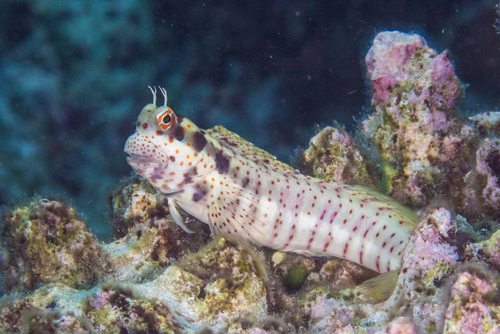
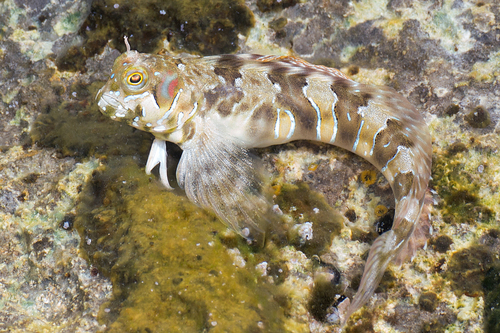
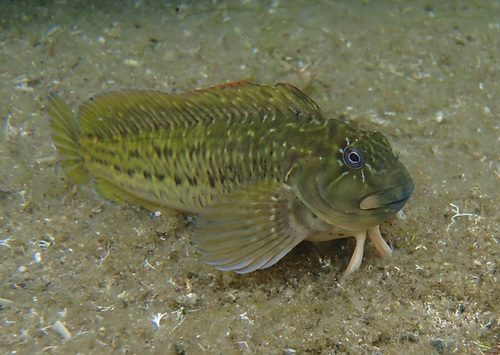
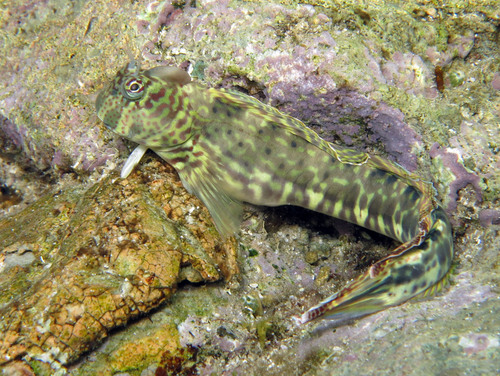
Istiblennius dussumieri is a dusky-colored fish species. It has six to seven irregular double dusky bars along its flanks, a dark spot on the anterior portion of the dorsal fin between the first two spines, and additional dark spots on both its dorsal and caudal fins. Females have scattered dusky spots across their bodies that correspond to the bands found on males, while males have broad dark margins on their dorsal, caudal, and anal fins. This species reaches a maximum total length of 12 cm (4.7 in).
Istiblennius dussumieri is distributed across the Indo-West Pacific region, and occurs marginally in the southeastern Atlantic. Its range extends eastwards from the Cape of Good Hope through the Indian Ocean and western Pacific as far as Palau, south to Lord Howe Island, and north to Taiwan. It was first recorded in the Ryukyu Islands of Japan in 2006.
This species inhabits very shallow rocky coasts, and is frequently found in the intertidal zone where water depth is less than 1 metre (3.3 ft). It prefers sheltered shorelines, where it often occurs alongside Istiblennius edentulus, and it can also be found in mangrove areas. Istiblennius dussumieri is oviparous and forms mating pairs. Its eggs adhere to the substrate, and its planktonic larvae live in shallow coastal waters.