About Issoria lathonia (Linnaeus, 1758)
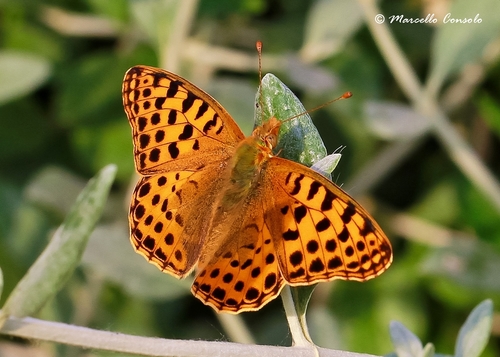
Issoria lathonia is a medium-sized butterfly with a wingspan of 38–46 millimetres (1.5–1.8 in). Its wings have a deep orange-violet background marked with rounded black spots arranged in regular rows; females have wings suffused with greenish gray. The underside of the hindwings features large pearly nacreous spots, crossed by a postdiscal row of black eyespots that have pearly pupils. A few pearly spots also occur at the apex of the forewings. Mature caterpillars can reach a length of 35 millimetres (1.4 in). They are grayish brown with black spots, relatively short brown spines that end in white tips, and a double row of white dorsal streaks. The suspended chrysalis is dark brown, with a large white saddle-shaped marking and several smaller white markings of the same color, giving it an appearance similar to a bird dropping. Adult Issoria lathonia are loosely similar in appearance to Speyeria aglaja, Fabriciana adippe and Brenthis daphne, which share the same orange wing upperside color, but these related species have different markings and spots. Additionally, the underside of their hindwings lack the large pearly spots that are characteristic of Issoria lathonia, also known as the Queen of Spain fritillary. This is a migratory species that is widespread across most of Europe, North Africa, the Canary Islands, and the eastern Palearctic realm, which includes Central Asia, the Himalayas, Baluchistan, and Western China. These butterflies occupy open habitats: dry lawns, agricultural wastelands, and extensive croplands, at altitudes ranging from sea level up to 2700 m.