About Isostichopus fuscus (Ludwig, 1875)
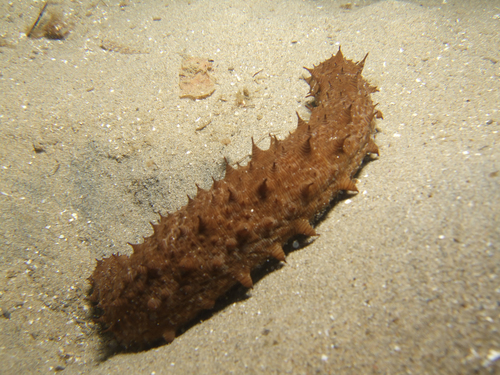
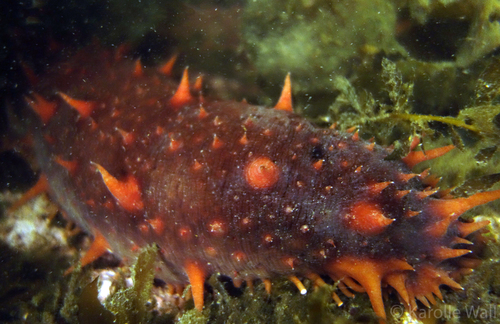
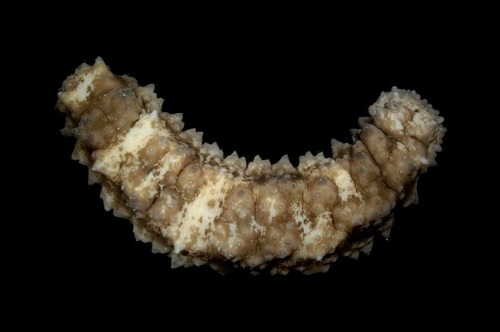
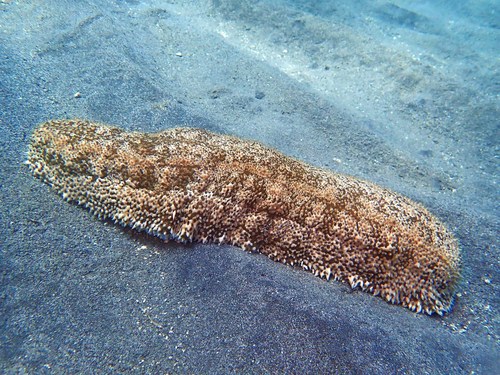
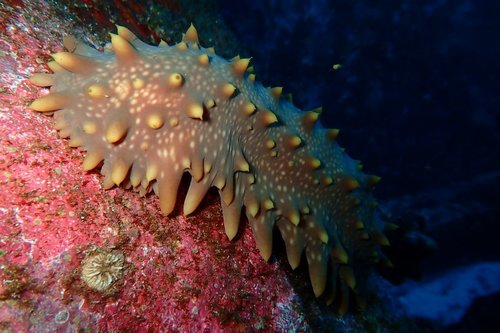
Isostichopus fuscus, commonly called the brown sea cucumber, is typically a small organism. Average body length reaches 23 cm, and average weight is 386 g; the largest recorded individuals grow up to 40 cm and weigh up to 830 g. Body weight varies seasonally based on reproductive status and maturity stage, and the species grows allometrically, meaning weight increases as body length increases. This species is dioecious, and gonads can only be identified and sexed under a microscope. There is no obvious external sexual dimorphism between individuals unless gonads are fully ripe. When gonads are ripe, male gonads are white, while female gonads are orange. Brown sea cucumbers have elongated, generally curved, half-circle-shaped bodies with a soft or gelatinous texture. They have dark brown base coloration spotted with orange papillae, and ambulacral extensions on their underside that aid in locomotion. Albinism was first recorded in this species in 2013, when two albino individuals were discovered: one in Loreto, Mexico, and the other in the Bay of Los Angeles. This species is distributed along the Pacific coast of Mexico (including the Gulf of California), extending south through Central America to the northern coast of Peru in South America, and also lives on eastern Pacific islands including the Galápagos. It inhabits shallow rocky reefs at depths between 0 and 40 m, and prefers depths between 3 and 29 m. It favors reef substrates that include sandy patches, and it predominates in areas with high abundance of Ulva seaweed. Brown sea cucumbers are more active at night; during the day they stay hidden to avoid being seen by predators. Spawning for I. fuscus occurs between July and September, and post-spawning gonads are present by October. Gametogenesis, the process of gamete production, takes place between January and July, and oogenesis (egg development) begins approximately one month before spermatogenesis (sperm development). The species is classified as an episodic spawner, marked by peaks in reproductive activity followed by sharp declines, and water temperature is thought to act as a major trigger for spawning. The annual reproductive cycle of the brown sea cucumber is divided into five gonadal stages: undetermined, gametogenesis, maturity, spawning, and post-spawning. In the undetermined stage, gonads or gametes are already present, and individuals are sexually viable, but existing gonads cannot be accurately distinguished as male or female at this point. Connective tissue is present in the lumen, and the gonadal wall is thickened. The remaining four stages differ between males and females. In males, the gametogenesis stage is called spermatogenesis, during which sperm builds up in the gonads. Folds are present in the gonadal wall that project into the lumen, spherical spermatocytes accumulate along the periphery, and this accumulation causes the connective tissue layer to decrease in thickness. In the maturity stage, gonadal follicles are filled with multiple layers of mature sperm. Mature spermatozoa are rounded and slightly flattened dorso-ventrally, and a thin layer of spermatocytes remains at the periphery. During spawning, sperm are released, so gonadal follicles are mostly empty. Developing spermatocytes are still present in the peripheral layer, a layer of connective tissue lines the gonad wall, the gonadal wall thickens, and internal folds are present. Spawning in males occurs throughout the summer months. After spawning, large numbers of phagocytes are present both inside and outside the follicles. Connective tissue is reabsorbed in the follicle gonadal wall, and remaining gonad tissue is engulfed by phagocytes, completing one reproductive cycle for males. In females, the gametogenesis stage is called oogenesis, during which young oocytes develop. Oogonia attach to the germinal epithelium of the lumen, oocytes are arranged in a single layer, and each oocyte has a defined nucleus with peripheral nucleoli. As oogenesis progresses, connective tissue and gonadal folds gradually reduce in size. In the female maturity stage, oocytes are fully mature and have reached their maximum size. Oocytes fill all tubules of the lumen, their peripheral nuclei are clearly distinguishable, connective tissue is completely absent, and the gonadal wall is very thin. Phagocytes surround the inside and outside of the lumen. During female spawning, most oocytes are released, so the number of oocytes drops greatly and no new gametes are present at this stage. A layer of connective tissue lines the gonad wall, the gonadal wall thickens, and internal folds are present. Any remaining oocytes are still in either the oogenesis or maturity stage. After spawning, the volume of remaining oocytes decreases significantly, large amounts of connective tissue are present in the gonadal walls, and phagocytes reduce the number of remaining gonadal structures, completing the female reproductive cycle. Hermaphroditic individuals are very rare, but have been collected. In these cases, male and female follicles were at different gonadal stages, and some hermaphroditic individuals had follicles in the spawning stage; in one case, both male and female follicles were in the spawning stage. Asexual reproduction may be possible for this species. Like most echinoderms, I. fuscus has strong regenerative ability. Laboratory experiments of induced transverse fission have been successful, with high survival rates and complete regeneration of both anterior and posterior body parts within a maximum of three months. These results suggest that asexual propagation could be a useful tool for restoring wild populations of this species. The brown sea cucumber is a highly valued commercial product across North and South American countries including Mexico, Costa Rica, and Ecuador, and sea cucumber fishing is the most important fishing activity in the Galápagos Islands. Because of high commercial demand, overfishing and overexploitation are major threats to this species. Due to its endangered status, the Galápagos Marine Reserve and major stakeholders monitored the Galápagos population twice yearly between 1999 and 2003 to assess the impact of fishing and identify potential solutions. The lowest recorded population density occurred after the 2003 fishing season, and full population recovery is considered unlikely due to ongoing legal and illegal fishing. Brown sea cucumbers are used in traditional Chinese medicine, and are eaten in many Asian and South American cuisines. Like other holothurians, the brown sea cucumber is a highly nutritious food: it is high in protein, low in fat, and contains many essential amino acids. It is commonly added to soups and stews, and in recent years, dried brown sea cucumber has been processed into tablets sold as a nutritional supplement. High demand for this species combined with unsustainable fishing practices has led to population declines for I. fuscus and many other holothurian species.