About Isopogon dubius (R.Br.) Druce
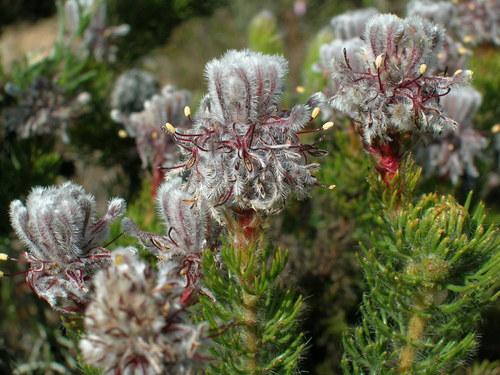
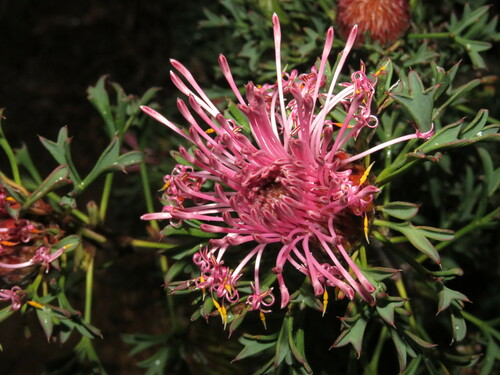
Isopogon dubius (R.Br.) Druce is a shrub that usually reaches 0.5 to 1.5 metres (1 foot 8 inches to 4 feet 11 inches) in height. It has reddish brown hairy branchlets, and both young branchlets and young leaves are covered in hairs. Its leaves are either deeply three-lobed or pinnate, measuring 25 to 55 millimetres (0.98 to 2.17 inches) long, and grow from a petiole around 20 millimetres (0.79 inches) long. The tips of the leaf lobes or leaflets are sharply pointed. The flowers are arranged in sessile, roughly spherical flower heads that are 40 to 50 millimetres (1.6 to 2.0 inches) in diameter. At the base of the flower head are numerous hairy, egg-shaped involucral bracts. Individual flowers are 25 to 30 millimetres (0.98 to 1.18 inches) long, pink to reddish pink in colour, and glabrous. Flowering takes place between July and September. After flowering, the fruit develops as a hairy nut, and multiple nuts fuse together to form a hemispherical head up to 30 millimetres (1.2 inches) in diameter.
This species grows in woodland and heath habitats, primarily on the Darling Range from near Wongan Hills to Narrogin. It occurs within the Avon Wheatbelt, Geraldton Sandplains, Jarrah Forest and Swan Coastal Plain regions of south-western Western Australia.
Isopogon dubius was first brought into cultivation in Europe in the 1800s. For good growth, it prefers dry summers and soil with excellent drainage, and it can tolerate moderate frosts. To produce the best flower display, it needs to be grown in full sun, though it can also be grown successfully in partial shade.