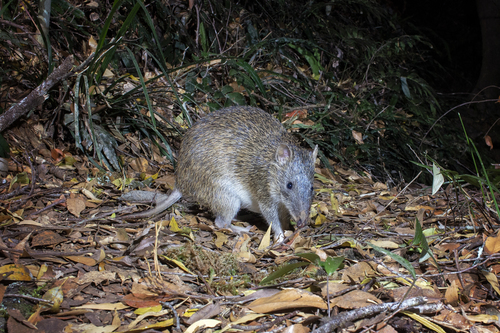
About Isoodon macrourus (Gould, 1842)
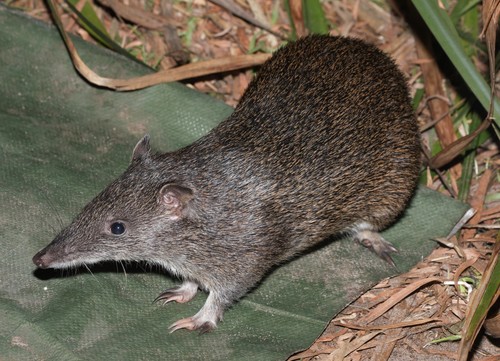
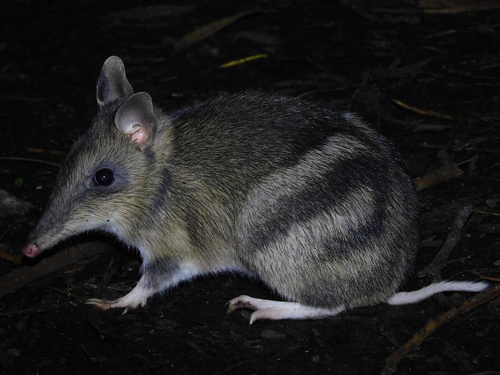
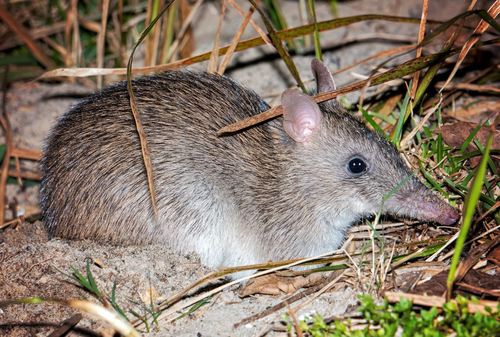
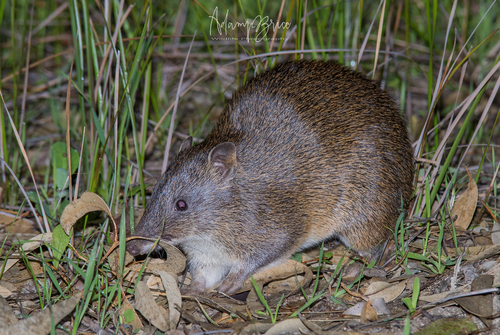
Isoodon macrourus, commonly called the northern brown bandicoot, can be distinguished from other marsupials by two key traits: it is polyprotodont, meaning it has several pairs of lower front teeth, and syndactylous. Typical body length for this species is 40 cm (15.7 in), and typical tail length is 15 cm (5.9 in). Average body weight is 1,200 g (2.6 lb). Males are typically 5–7 cm (2.0–2.8 in) longer and around 0.5 kilograms (1.1 lb) heavier than females. This marsupial has a thick, harsh coat that is not spiny. Its dorsal fur is light brown with scattered black speckles across the body, while its ventral surface is solid white. The northern brown bandicoot has a reversed pouch that prevents soil from filling it while the animal digs. It also has short, rounded ears and a short snout. It is easily confused with the southern brown bandicoot; the two species differ in size (the northern brown bandicoot is the larger of the two) and geographic range, as the southern brown bandicoot is found only on Australia's southern coastline. Northern brown bandicoot populations occupy two distinct habitats depending on the season: dry season and wet season. During the dry season, the species lives in thick vegetation made up of tall weeds, small trees, and dense shrubs, likely due to the limited food available at this time. In the wet season, northern brown bandicoots move out to roam open grasslands, where food sources are more abundant. The northern brown bandicoot is one of the few native Australian ground-dwelling mammal species that can survive in urbanized landscapes. Its generalized diet and habitat requirements, paired with high reproductive output, allow the species to persist in fragmented urban habitats. Northern brown bandicoots build individual ground nests or shelters from simple mounds of hay and twigs; these structures are well camouflaged, waterproof, and have a hollow interior large enough to hold only one bandicoot. Some individuals use hollowed tree trunks or abandoned rabbit burrows as shelter. Overall, the northern brown bandicoot strongly prefers to live in areas with low ground cover. It is an omnivorous species that feeds on insects, earthworms, berries, and grass seeds. Occasionally, when food is scarce, female bandicoots will eat their own young. This marsupial forages alone at night and relies on a keen sense of smell to locate food that is either on the surface or buried underground. Nocturnal foraging leaves the northern brown bandicoot as primary prey for many nocturnal Australian predators including cats, foxes, and owls. It also acts as a host for Australiformis semoni, an Acanthocephalan intestinal parasite.