About Isocoma acradenia (Greene) Greene
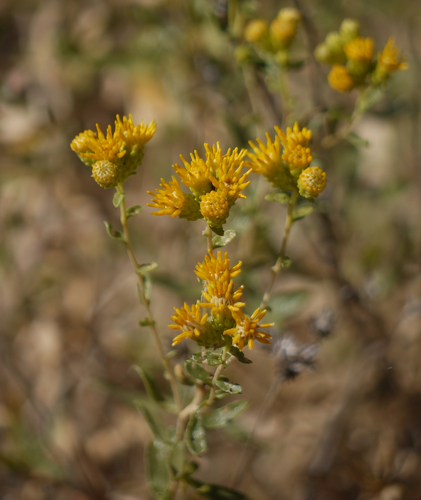
Isocoma acradenia, known by the scientific name Isocoma acradenia (Greene) Greene, is a bushy subshrub that grows to a maximum height of slightly over 1 meter (39 inches). It produces erect, branching stems that are shiny pale yellowish white when young, turning yellow-gray as they age. The tough, hard-surfaced stems bear linear or oval-shaped glandular leaves between 1 and 6 centimeters (0.39 to 2.36 inches) long. These leaves sometimes have stumpy teeth along their edges, are gray-green when fresh, and fade to pale gray or tan as they age. Inflorescences located along the upper sections of the stem branches consist of clusters of four or five flower heads. Each flower head forms a capsule encased in bumpy, glandular greenish phyllaries, and holds many golden yellow disc florets at its opening. Each disc floret is slightly cylindrical and protruding. The plant produces an achene fruit a few millimeters long, with a yellowish pappus that adds a few additional millimeters to its length. There are three recognized varieties of this species. Isocoma acradenia var. acradenia grows in salt scrub, often alongside creosote, and is found in Arizona, California, Nevada, and Sonora. Isocoma acradenia var. bracteosa (Greene) G. L. Nesom grows on salt flats in the southern Central Valley of California. Isocoma acradenia var. eremophila (Greene) G. L. Nesom grows in sandy soils, dunes, and similar habitats, and is found in Arizona, California, Nevada, Utah, Baja California, and Sonora.