About Isistius brasiliensis (Quoy & Gaimard, 1824)
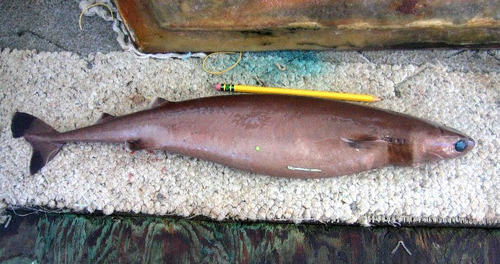
The cookiecutter shark (Isistius brasiliensis) has an elongated, cigar-shaped body with a short, bulbously rounded snout. A very short flap of skin sits in front of each nostril. Its large, oval, green eyes are positioned forward on the head, but do not provide extensive binocular vision. Large spiracles are located behind the eyes, on the upper surface of the head. Its short mouth forms an almost straight transverse line, and is surrounded by enlarged, fleshy, suction-capable lips. The upper jaw holds 30–37 teeth, while the lower jaw holds 25–31 teeth, with tooth counts increasing as the shark grows. Upper and lower teeth are extremely different: upper teeth are small, narrow, upright, and taper to a single smooth-edged cusp. Lower teeth are also smooth-edged, but much larger, broader, and knife-like, with interlocking bases that form a single saw-like cutting edge. The five pairs of gill slits are small. The pectoral fins are short and roughly trapezoidal in shape. Two spineless dorsal fins are set far back on the body; the first originates just ahead of the pelvic fins, and the second is located just behind. The second dorsal fin is slightly larger than the first, and the pelvic fins are larger than either dorsal fin. The anal fin is absent. The caudal fin is broad, with a lower lobe almost as large as the upper lobe, which has a prominent ventral notch. The dermal denticles are squarish and flattened, with a slight central concavity and raised corners. The cookiecutter shark is chocolate brown, becoming subtly lighter on its underside, and a dark "collar" wraps around its gill region. All fins have translucent margins, except the caudal fin, which has a darker margin. Complex light-producing organs called photophores densely cover the entire underside except the collar, and produce a vivid green glow. The maximum recorded length is 42 cm (17 in) for males and 56 cm (22 in) for females. The cookiecutter shark inhabits all of the world's major tropical and warm-temperate oceanic basins, and is most common between 20°N and 20°S latitude, where surface water temperatures are 18–26 °C (64–79 °F). In the Atlantic, it has been recorded off the Bahamas and southern Brazil in the west; off Cape Verde, Guinea to Sierra Leone, southern Angola, and South Africa in the east; and at Ascension Island in the south. In the Indo-Pacific, it has been caught from Mauritius to New Guinea, Australia, and New Zealand (including Tasmania and Lord Howe Island), as well as off Japan. In the central and eastern Pacific, it occurs from Fiji north to the Hawaiian Islands, and east to the Galápagos, Easter, and Guadalupe Islands. Fresh wounds found on marine mammals suggest this shark may range as far north as California during warm years. Catch records indicate the cookiecutter shark performs a diel vertical migration of up to 3 km (1.9 mi) in each direction daily. It spends the day at depths of 1–3.7 km (0.62–2.30 mi), and rises into the upper water column at night, usually staying below 85 m (279 ft), though it rarely ventures all the way to the surface. This species may be more tolerant of low dissolved oxygen levels than sharks in the related genera Euprotomicrus and Squaliolus. It is frequently found near islands, possibly for reproduction or because islands host congregations of large prey animals. In the northeastern Atlantic, most adults are found between 11°N and 16°N, with the smallest individuals found at lower latitudes and the largest at higher latitudes. There is no evidence of sex segregation. The cookiecutter shark is best known for biting neat, round chunks of tissue from marine mammals and large fish. It is classified as a facultative ectoparasite, because it also fully ingests smaller prey. It has a wide gape and a very strong bite, made possible by heavily calcified cranial and labial cartilages. With small fins and weak muscles, this ambush predator spends much of its time hovering in the water column. Its liver can make up around 35% of its total weight, and is rich in low-density lipids that let the shark maintain neutral buoyancy. This species has a higher skeletal density than Euprotomicrus or Squaliolus, and its body cavity and liver are proportionately much larger, with a much higher oil content. Its large caudal fin allows it to make quick bursts of speed to catch larger, faster prey that come within range. Like other sharks, the cookiecutter shark regularly replaces its teeth, but it sheds entire rows of lower teeth at a time rather than one tooth at a time. Researchers estimate that a cookiecutter shark sheds 15 sets of lower teeth, totaling 435–465 teeth, between when it is 14 cm (5.5 in) long and when it reaches 50 cm (20 in), representing a significant investment of resources. The shark swallows its old sets of teeth to recycle the calcium they contain. Unlike other sharks, the retina of the cookiecutter shark has ganglion cells concentrated in a concentric area rather than in a horizontal streak across the visual field; this arrangement may help the shark focus on prey directly in front of it. This shark is known to travel in schools, which may increase the effectiveness of its bioluminescent lure and discourage attacks by much larger predators.

