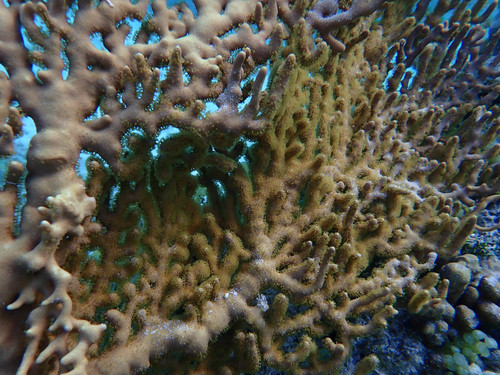
About Isis hippuris Linnaeus, 1758
Isis hippuris Linnaeus, 1758 is a soft coral identified by its yellow-green coloration and thick stalks with a fuzzy appearance. Colonies of I. hippuris commonly grow to a height of 30–40 cm and a width of 10–20 cm, but colonies have been recorded growing to 100 cm in either dimension. The physical structure of I. hippuris is composed of nodes and internodes, essentially "stacked" on top of each other, giving it the nickname sea bamboo. Together, the nodes and internodes can create either a slender or thick structure, and often look similar to the spine of many organisms. For this reason, I. hippuris has also been called "the stony horse-tail", as its structure is its main distinguishing identifying characteristic. A 2015 study of the nodes and internodes of I. hippuris found that the coral may display multiple phenotypes depending on its environment. The study compared groups of I. hippuris located on two different ridges within Wakatobi Marine National Park (WMNP), Indonesia. The ridges differed in sediment thickness, height, and color. One phenotype had shorter, stockier branches, while the other had longer, thinner branches. It is not entirely clear if these differences indicate differing phenotypes, or if the two ridges host distinct species. I. hippuris is found on tropical coral reefs within the Indo-Pacific region of the Pacific Ocean, particularly off the coasts of Indonesia and India. I. hippuris may be adaptable to its environment, as factors such as sediment thickness, turbidity, and light availability may be linked to phenotypic differences. Specimens of I. hippuris with longer stalks and more vertical profiles are commonly found on reef flats, while specimens with shorter stalks and more horizontal profiles are found on reef crests. I. hippuris is one of many gorgonian corals found throughout Indo-Pacific coral reefs. Gorgonian corals are often dominant members of the benthic communities they inhabit, acting almost as centerpieces for the reefs. Like most gorgonians, I. hippuris prefers areas with loose substrates and strong water flow. Areas with differing underwater elevations appear to be ideal for diverse groups of gorgonians, both for overall species richness and for differing phenotypes of I. hippuris. Areas with high turbidity and sedimentation are not suitable for gorgonians. Like other members of the class Anthozoa, I. hippuris is able to reproduce asexually, spawning small larvae that go through metamorphosis quickly and take root in sediment to grow into adults.

