About Iris variegata L.
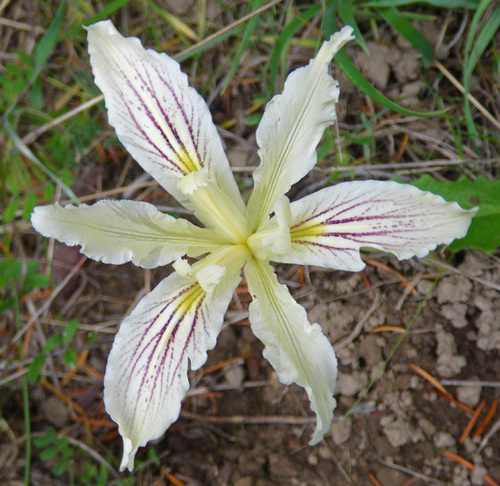
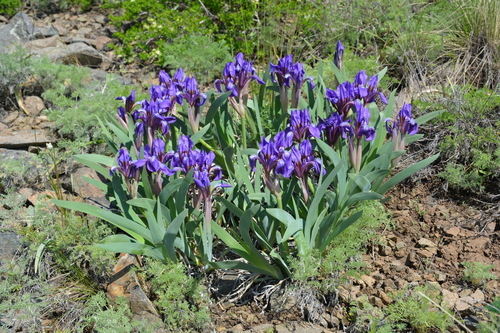
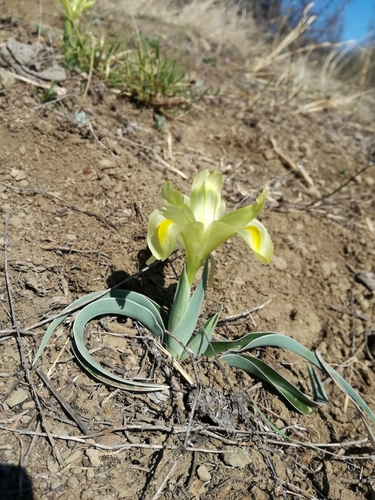
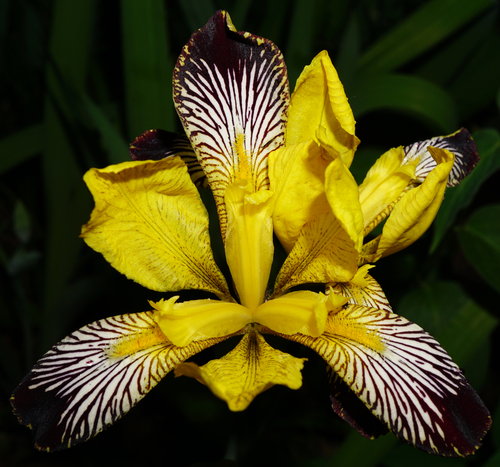
Iris variegata has often been confused with Iris pallida 'Argentea Variegata', which has variegated leaves. Unlike this similar plant, Iris variegata has variegated flowers. It grows from a stout rhizome, with roots that can reach up to 10 cm deep in the ground. Its leaves are approximately 1–3 cm wide, dark green, ribbed, and slightly falcate, or sword-shaped. In the wild, it varies in height from 30 to 45 cm, and it generally grows up to 45 cm (18 in) tall. Its branched flowering stems can grow as tall as its leaves. Normally, each stem produces 2–3 flowers. These scentless flowers bloom in early summer, between May and June. The perianth tube measures 2–2.5 cm long. The flowers are yellowish-white with brown-purple veins on the falls, and overall are about 5–7 cm wide. The falls are obovate-oblong shaped and nearly 2 cm wide, yellow with purple or chestnut brown veins that grow darker closer to the apex. It has a yellow beard in the center on the lower part of the fall. The standards are erect, and their color varies from pale yellow to bright yellow and gold. It produces a seed capsule that measures 2.2–2.8 cm long by 1–1.3 cm wide, with 6 ribs along its edge.
Iris variegata is native to parts of Europe, specifically found in the Pannonian region (an ancient Roman province) of central Europe. It occurs in southern Moravia, southern Slovakia, south-western Germany, southern Romania, Bulgaria, western Ukraine, Croatia, Czechoslovakia, Serbia, Hungary, and Vienna, Austria. It has also been introduced into Switzerland, Bohemia, and Italy. It prefers to grow in open stony areas, amongst scrub and light woodland, on sunny steppe slopes, and beside forest margins.
This species is extremely hardy. After flowering, its leaves die completely away in autumn, and the plants remain dormant until spring, when they regrow new leaves and stems. It grows best when cultivated in well-drained fertile soils, but it is tolerant of partial shade. It can be easily grown in gardens in Kashmir. Lifting, dividing, and replanting the rhizomes is best done once flowering has finished, as this is when the plant grows new shoots that will flower the following year. To plant, rhizomes are placed on the soil surface facing the sun, with at least 45 cm of open ground in front of them to allow two years of growth and flowering. The plant is held in place by removing half of the leaf mass to reduce wind rocking, and by using the old roots as anchors in the soil. The rhizome is placed on thoroughly dug ground, and the roots are positioned on either side into 10 cm deep grooves. Soil is then gently firmed around the roots to hold the plant steady. New roots and leaves grow rapidly as the rhizome moves forward. Iris variegata can also be propagated by seed.