About Iris tridentata Pursh
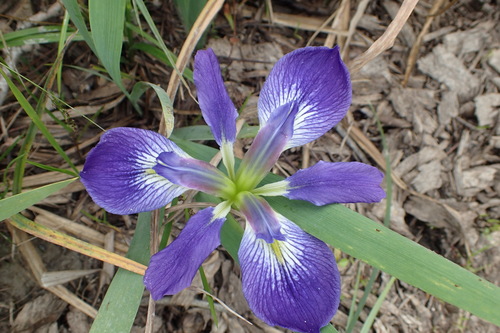
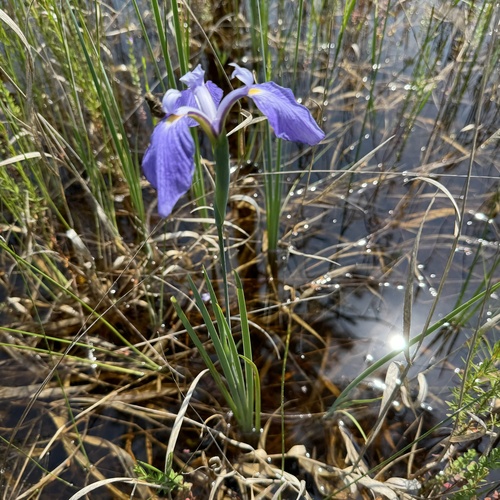
Iris tridentata Pursh has unique flower and growth characteristics that distinguish it from other irises, including the other two species in Iris series Tripetalae. Multiple botanists have noted distinct features of its rhizome: W. R. Dykes described it in 1913 as "almost stoloniferous", J. K. Small noted in 1933 that "the cord-like rootstocks are peculiar", and R. K. Godfrey and J. W. Wooton wrote in 1979 that it is "clothed with coarse, strongly many-ribbed, brown, overlapping scales". The slender rhizomes branch very easily to form large spreading colonies. They are typically 1.5–2 cm in diameter, covered with coarse, strongly ribbed, brown, scale-like leaves, and produce roots at their nodes. Plants reach a mature height between 30 and 70 cm (12 to 28 inches). The flowering stem is usually taller than the surrounding leaves, measures 3–7 cm in diameter, and bears 1 to 3 branches (most commonly one) that each hold one flower. In late spring, new bright green leaves emerge and lengthen from the base of the plant, growing 30 to 50 cm (one foot to 18 inches) long. These leaves are upright and sword-shaped, 1.5 to 2.3 cm wide, occasionally have red-brown edges, and can encircle the plant's stem. Iris tridentata produces fragrant flowers in spring, between May and June. Flowers come in a range of blue shades including violet, violet-blue, purple, purple-blue, and blue, with darker purple veining and a yellow-white signal. Very similar to Iris virginica, it has very small, bristle-free flower standards that are about 1.5 cm long. Its sepals are about 7–8 cm (2.8–3.1 inches) long, and its perianth tube is about 2–2.5 cm long. After flowering, it forms a seed capsule between August and October. The capsule is globular to oblong shaped, and measures about 2.5–4 × 2 cm. Inside the capsule are dark red-brown, semi-circular, flattened seeds that are about 6–8 mm wide, which are very similar to seeds of Louisiana irises or Iris virginica. In cultivation, Iris tridentata is hardy to USDA Zones 5 to 8. It grows well in partially shaded locations with acidic soil in gardens, and works well planted in butterfly gardens. It is also classified as a bog garden plant, and tolerates growth at waterside edges. Over winter, leaves typically die back depending on winter severity, and re-sprout the following spring. Newly planted specimens take one year to establish before they begin flowering. This species can be grown in large pots or containers. It is rare in cultivation in the UK, because it is not sufficiently hardy there. It is listed in A Fifth Checklist of Tennessee Vascular Plants, and preserved specimens are held at the Florida Museum of Natural History.