About Iris sibirica L.
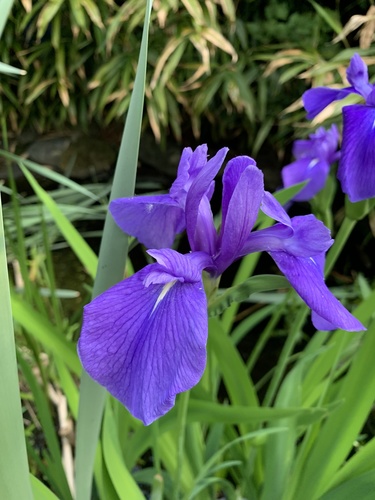
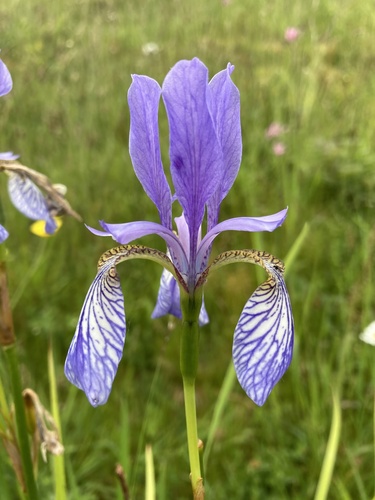
Iris sibirica L. was often confused with Iris sanguinea, another blue-flowering Asian iris, but I. sanguinea has unbranched stems, while I. sibirica has branched stems. It forms a dense clumping plant from a creeping rhizome, which is approximately 0.9–1.2 cm (0.35–0.47 in) in diameter. Rhizomes are covered in brown remnants of old leaves from previous growing seasons. It produces green, grass-like leaves that are ribbed, and sometimes have a pink tinge at the base. Leaves grow between 25–80 cm (10–31 in) long and 0.4–0.6 cm (0.16–0.24 in) wide, and are normally shorter than the plant’s flowering stems. In autumn, the foliage turns yellow then dies back for winter, re-emerging again in spring. It has a hollow, slender stem that branches 1–3 times and grows up to 50–120 cm (20–47 in) long. Stems bear 2–5 flowers, most often three, at the terminal ends, blooming between late spring and early summer from May to June. It has 3 brown paper-like spathes (the bud leaves), which are reddish at the base and measure between 3–5 cm (1–2 in) long. Flowers come in a range of blue shades, from violet-blue to blue, and occasionally white. Flowers are 6–7 cm (2–3 in) in diameter. It has 2 pairs of petals: 3 large outer sepals called 'falls' and 3 smaller inner petals (or tepals) called 'standards'. The drooping obovate falls are 5–7 cm (2.0–2.8 in) long and 2–2.5 cm wide, with a wide flaring white central blade or signal marked with dark-blue to violet veining. White-flowered forms of the iris have a lavender tinge and dark veining. The smaller, narrow upright standards are between 4.5–5 cm (1.8–2.0 in) long and 1.5–1.8 cm wide. It has a light to dark blue-violet circular perianth tube about 1 cm long, a pale blue style about 4–5 cm (1.6–2.0 in) long, a pedicel between 1–15 cm long, and a roundly triangular ovary 1.5–2 cm across. After flowering, it produces a short, stubby, roundly triangular seed capsule with low ridges along its angles, measuring 3–4.5 cm by 1–1.3 cm. Inside the capsule, 2 rows of thin, flat, capital D-shaped dark brown seeds grow, each seed measuring about 5 mm by 3 mm. Iris sibirica is native to temperate areas between Europe and Central Asia, and has the widest distribution range of all species in the Siberian iris series. Within Europe, it is found in west France, Italy, Switzerland, Austria, Czech Republic, Slovakia, Germany, Hungary, Poland, Romania, Bulgaria, Former Yugoslavia, Belarus, Estonia, Latvia, Lithuania, Moldova, Ukraine and northern Turkey. It occurs in the Caucasus regions of Armenia, Azerbaijan, and Siberia (Russian Federation), and extends east to Lake Baikal in Siberia. It is recorded alongside Iris bloudowii, Iris glaucescens, Iris humilis, Iris ruthenica, Iris tenuifolia and Iris tigridia as found in the Altai-Sayan region, where Russia, China, Mongolia and Kazakhstan meet. It has also become naturalized in various areas of North America, including Ontario (Canada), and the U.S. states of Connecticut, Maine, Massachusetts, New York, Pennsylvania, Virginia and California. It grows in damp woodland, wet meadows, grasslands or pastures, reed swamps by lakes, and beside streams. It generally receives abundant moisture from mountain snowmelt, flooding streams and saturated riparian areas. In North America, it is found growing in damp ditches beside roadsides. Like many other irises, most parts of this plant (rhizome and leaves) are poisonous. Accidental ingestion can cause stomach pains and vomiting. Handling the plant may also cause skin irritation or an allergic reaction. However, an edible starch has been extracted from this plant in China, similar to extracts from Iris ensata. Its root has also been used to make an insecticide and an expectorant. Generally, 28-chromosome hybrids of Iris sibirica are easier to grow than Sino-Siberian varieties. The iris can tolerate temperatures down to −20 °C (−4 °F). It is hardy to USDA Zones 2–8, and to European Zone H1, which is hardy to −20 °C (−4 °F) and as low as −40 °C (−40 °F). It is hardy in the United Kingdom. Winter mulching allows the plants to withstand even colder temperatures. This iris should be grown in well-drained, fertile, neutral to slightly acidic soils, with a pH level above 5.6. If soil has a high sand or clay content, large amounts of organic material such as compost or well-rotted manure should be mixed into the soil at planting time. It prefers full sun positions, but can tolerate partial shade as long as it receives some hours of sunlight. In very hot, arid regions, it needs some shade, regular watering and mulching. The plant needs moisture during the growing season (spring and early summer) to produce its best blooms. Although it can tolerate occasional flooding, it does not grow in standing water. As Vita Sackville-West noted, ‘…it will do well by the waterside in a fairly damp bed, although it does not like being drowned underwater all year round.’ It can be used in many different garden positions, including waterside locations beside pools, ponds or streams. It is also known as an ideal bog garden plant, and works well in herbaceous borders. It can be planted in mixed groupings with grasses and other perennials to create naturalized gardens and meadows. It is a sturdy plant and does not need staking. The UK National Collection of Siberian Irises is held at Lingen Nursery, on the Welsh border. The aphid Aphis newtoni can be found on this plant, and the iris weevil Mononychus punctumalbum can also attack the plant's seeds. Johan Peter Falk recorded that the Tara Tartars of Russia (West Siberia) coloured cloth yellow using Iris sibirica flowers, while the Votyaks, Mordvins and Kalmyks obtained red dye from Galium species. Iris sibirica has also been used to make a drug used as an emetic and laxative. An old traditional pre-wedding night practice reports that Polish girls ate cooked Iris sibirica fruit (seeds) to improve contraception.