About Iris setosa Pall. ex Link
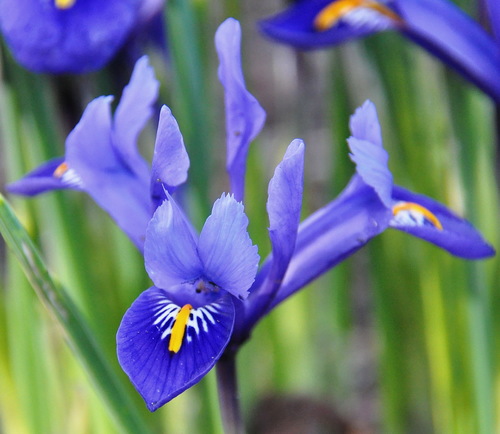
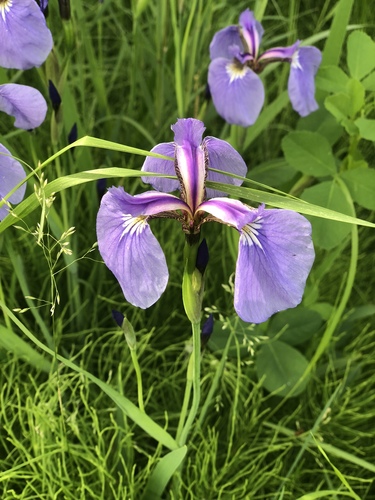
Iris setosa Pall. ex Link is similar in form to a miniature Japanese iris, or a shorter-lived dwarf version of Iris sibirica. Its large, branching, shallowly rooted rhizomes spread over time to form large clumps. The thick, grey-brown rhizomes are covered in old maroon-brown fibrous material, which are the remains of the previous season's leaves. I. setosa has branched stems that vary greatly in height, from 10 cm (5 inches) to 1 m (3 feet) tall; larger plants can grow taller than their own leaves. The roundish stems are 1.5–9 cm (0.6–4 in) in diameter and have 1 to 3 branches. Iris setosa has grass-like, lanceolate (sword-shaped), medium-green leaves with purple-tinged bases. Leaves measure 30–60 cm (12–24 in) long by 0.8–2.5 cm (0.3–1 in) wide. Each stem bears 3–4 flowers, grouped in sets of 3, for a total of 6 to 13 flowers across the whole plant. It blooms between June and July. The large flowers measure 5–8 cm (2–3 in) across, usually 7–8 cm (2.8–3.1 in). Flower color ranges across shades of blue and purple, including violet, purple-blue, violet-blue, blue, and lavender, depending on growing location. Pink or white flower forms occur very rarely. Like other irises, I. setosa has two sets of three petals: three large outer sepals called "falls," and three smaller inner petals (or tepals) called "standards." The sepals have deep dark purple veining and a yellow-white center called a "signal." The standards are extremely small, reduced almost to bristles, which gives the flower a flat, three-petaled appearance. The perianth (floral) tube is about 1 cm (0.4 in) long, and is normally dark blue-violet to red-purple with darker veins. I. setosa is a hermaphrodite that self-fertilizes, and can also be pollinated by insects. Its stamens are about 2 cm (0.8 in) long with purple anthers, and its ovary is about 1 cm (0.4 in) long. After flowering finishes, seeds ripen between August and September. Seeds are held inside a green, loculicidal, cylindrical seed capsule that measures 2.5 cm by 1.25 cm and turns pale brown when ripe. The capsule has 6 ribs along its sides. The pale brown to dark red seeds are about 2–3 mm in size, and have a distinct raised raphe (tissue ridge) along the length of one edge.
Iris setosa is the only iris species native to both Asia and North America, and has a circum-arctic distribution. In the United States, it ranges north to the Brooks Range and south to South-Central Alaska and the coastal Aleutian Islands in Alaska, and also grows in Maine. In Canada, its range includes British Columbia, Newfoundland, Quebec, and the Yukon Territory. The Canadian form of I. setosa is thought to differ slightly from the Asian form. In Canada, it grows as far south as the shores of the Gulf of St. Lawrence and as far north as the estuary of Saint-Vallier, in Bellechasse county, Quebec. In Russia, it grows near the lower Lena River in Siberia. In China, it is found in Manchuria and eastern Jilin. In Japan, it occurs on Hokkaido and extends south to Honshu, with large populations in Akkeshi, eastern Hokkaido. It is also found in Korea. I. setosa grows in many Alaskan national parks including Glacier Bay, Kobuk Valley, Lake Clark, Wrangell–St. Elias, Katmai, and Kenai Fjords, and also in Acadia National Park in Maine; its range is not limited to national parks. It does not grow north of the Brooks Range in Alaska.
Iris setosa is normally classed as a wetland plant, but it also grows well in dry soil. It tolerates many habitat types, and can be found in meadows, bogs and swamps, alongside rivers, streams, and lakes (especially on rocky shores), on beaches, dunes and headlands, and in open light woodland. It can grow in gravelly soils and even sand. It is normally found at elevations between 1,500–2,500 m (4,900–8,200 ft) above sea level.
Iris setosa adapts to a wide range of growing conditions, with the exception of heavy clay soils that dry out during summer. It prefers moist or wet soils, and can tolerate bog conditions, especially during the growing season when it requires large amounts of moisture. It dislikes soils that contain lime, and prefers growing in partial shade, as full sun increases the risk of drought. It is also well-suited to sunny areas of woodland gardens or bog gardens, and works well when planted at the front of a border. Miniature versions are suitable for rock gardens or garden sinks. Like other rhizomatous irises, I. setosa rhizomes should be planted with their top surface left uncovered by soil; if covered or planted too deeply, the rhizome is at risk of rotting. In mild temperate regions, the leaves are evergreen and can survive winter. If leaves are trimmed before winter to reduce wind rock and root disturbance, new leaves will emerge in spring. Some sources claim irises are deer-proof, but this is thought to be incorrect; it may simply be that leaves regrow after being eaten by deer. Two species of aphid, Macrosiphum euphorbiae and Myzus ornathus, can infest the plant.
Herbalists have used the rhizome of Iris setosa for centuries as an ingredient in various medicines, similar to how Orris roots are used. All parts of Iris setosa are poisonous when raw. The rhizome contains iridin, an oleoresin that can affect the liver and digestive organs, and cause vomiting, diarrhea, or allergic reactions including severe rashes. Alaska Natives have used it as an ingredient in arrow poison. Although poisonous raw, the plant's starchy roots can be made safe for human consumption by cooking, and the plant is cultivated in Japan for these edible roots. Some Inuit tribes in Alaska roast and grind the seeds to use as a coffee substitute. The Aleuts made a drink from the roots to use as a laxative, while the Iñupiat considered the whole plant poisonous. Some traditional healers made a tincture from the roots, used in very small amounts to soothe lymphatic swelling. The plant was also combined with Arnica to make an herbal oil to relieve bruising pain. Flower petals can be used with a chrome mordant (fixing agent) to create a violet-blue dye, and petals were also used as a grass dye for baskets. Rhizomes can be processed to extract a perfume with a scent similar to violet essence.