About Iris savannarum Small
Iris savannarum Small differs from Iris hexagona in several key features: Iris hexagona has hexagonal seed capsules, while Iris savannarum has rounded capsules; Iris hexagona has yellow-green leaves, while Iris savannarum has bright green leaves; and Iris hexagona blooms one month later than Iris savannarum.
This species has a greenish rhizome between 2 and 2.5 cm in diameter, covered in fibrous remains of the previous season’s leaves. The rhizome branches easily, forming large open clumps or colonies that can sometimes span entire acres. The rhizome is poisonous to humans. Stems grow 30–100 cm long and produce one branch. Bright green, grass-like leaves grow from the plant’s base, reaching roughly 60–100 cm long and 0.8–2 cm wide; they typically die back after flowering finishes.
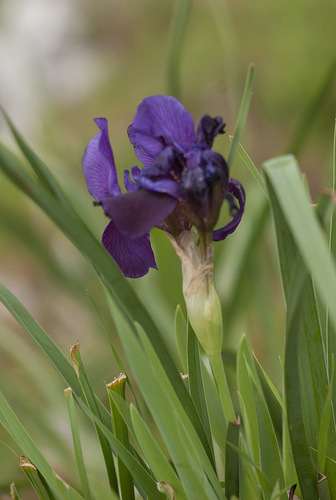
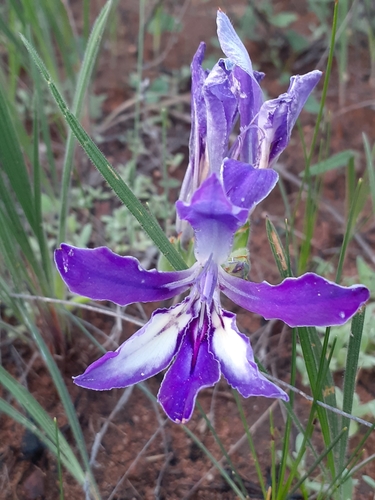
Iris savannarum blooms between spring and summer, generally from March to April. Each stem holds 1 to 3 flowers, which range in color from violet-blue to blue to white. The white form was originally described as Iris albispiritis, before being reclassified as a synonym of Iris savannarum. The perianth tube is 1.2–1.5 cm long. Its blue or pale violet sepals are flecked with white, marked with deep blue veining on either side of the central ridge, and measure about 7–8 cm long. The central ridge is yellow, with a light green claw.
It produces a bright green ellipsoid seed capsule 6–10 cm long. The capsule has 6 sharp, equally spaced wing-like ridges that converge to form a stout beak at the apex. Inside the capsule are brown, circular or lozenge-shaped seeds 8–12 mm in diameter. The seed capsules are often too heavy for the flower stems, causing the stems to bend down to the ground or water, depending on the plant’s habitat. When seeds are released, those that land near water float thanks to a cork-like coating, and they can also drift on the wind to establish new colonies.
This species is pollinated by insects, most commonly bees. Iris savannarum flowers have a small flap that covers the stigma to prevent self-pollination. When a bee lands on the flower to collect pollen, it brushes past the flap as it moves toward the anther. The bee collects pollen from the anther and deposits pollen it brought from other flowers, then brushes against the stigma flap on its way out, closing the flap again.
Iris savannarum is native to the southeastern United States, where it occurs in Alabama, Georgia, and Florida. It is the most southerly occurring iris species in the United States. Its primary distribution is in Florida, where it outnumbers other iris species and forms many small to medium-sized colonies across the state. Its range in Florida includes Sarasota County, and extends as far south as Big Cypress Swamp in Monroe County. It prefers open freshwater swamps, and grows well in both rich loamy sandy soils and poor sandy loam soils. It is tolerant of both permanently wet and permanently dry soils.