About Iris longipetala Herb.
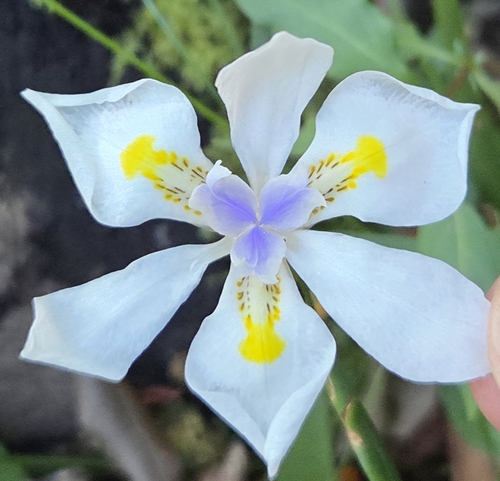
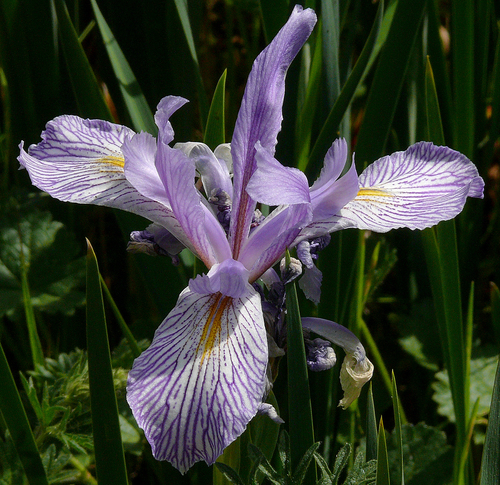
Iris longipetala Herb. has a rhizome approximately 10–25 mm in diameter, with small trailing branches roughly 2–2.5 cm in diameter and numerous fleshy roots. Its spreading growth habit makes it a clump-forming plant, and it can create dense colonies. It produces a small stem that reaches 30–60 cm (0.98–1.97 ft) in height, with 1 or 2 branches and a diameter of 3–6 cm. Three overlapping leaves grow along the stem, wrapping around it. Leaves are either dark green or bluish green, and are roughly equal to or slightly shorter than the flowering stems. They emerge from the base of the plant, growing in a grass-like shape, and are generally 5–11 mm wide. This species is briefly deciduous; leaves turn grey or yellow-brown when dying back, then re-emerge quickly to give the plant an overall evergreen appearance. Each stem holds 3–8 flowers, which bloom in spring (March–April) in its native range, or in summer when grown in Europe. The lilac-purple perianth tube measures 3–8 cm in length. Flowers are large, 10–15 cm (4–6 inches) across, with narrow petals. They are very lightly scented, and come in a range of shades from creamy-white and pale blue to lavender blue. Each flower displays purple veining ranging from lilac to dark purple, and the falls often have a faint yellowish signal patch. Flowers have 2-lobed stigmas. After flowering, it produces an oblong-ovoid seed capsule approximately 2 inches long, narrowed at both ends. The capsule has 6 ribs running along its length, and is almost round in cross-section. Inside are wrinkled, dark brown, globular pyriform seeds. Iris longipetala is native to North America, specifically the western United States in the state of California. It grows from Mendocino County down to Monterey County, around the San Francisco Bay Area, and can also be found on the Twin Peaks hills of San Francisco. It inhabits coastal grasslands in moist open spaces, and is also found in grazed pastures because it is resistant to cattle. It grows at altitudes below 600 m (2,000 ft) above sea level. Like many other irises, most parts of the plant (the rhizome and leaves) are poisonous. Accidental ingestion can cause stomach pain and vomiting, and handling the plant may trigger skin irritation or an allergic reaction. It is hardy to USDA Zone 3, and is not hardy below 10 degrees F. It can be planted in full sun or partial shade; it tolerates full sun in coastal areas and prefers light shade in inland areas, and needs regular watering during the blooming period. It requires less water after flowering finishes. It prefers well-drained soils, and can survive long periods of summer dryness except in hot inland locations. It is both deer resistant and cattle resistant, because its foliage is unpalatable to these animals. It can tolerate wet heavy soils including clay. It is suitable for cultivation in garden borders and at the fringes of shrubberies in sandy loam soils, and may also be appropriate for pond margins or bog gardens. Specimens of this species are held at the Royal Botanic Garden Edinburgh. Two species of aphids, Aulacorthum solani and Rhapalosiphonius staphyleae, can be found feeding on this plant.