About Iris kemaonensis Wall. ex D.Don
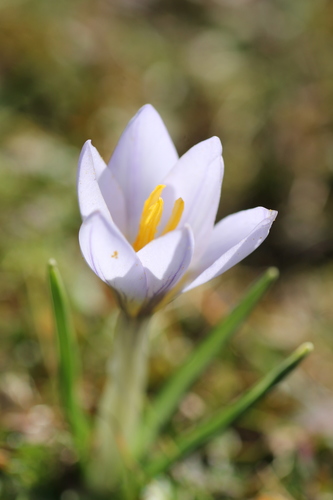
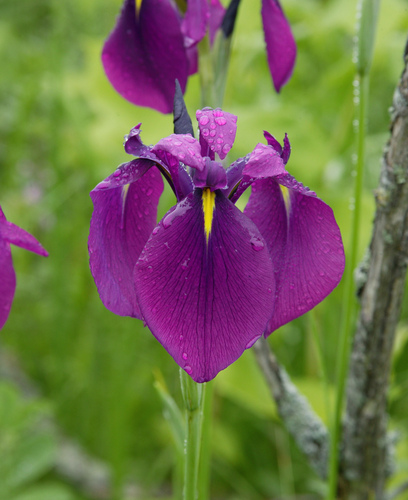
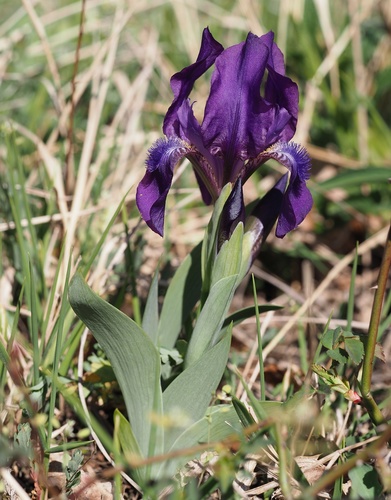
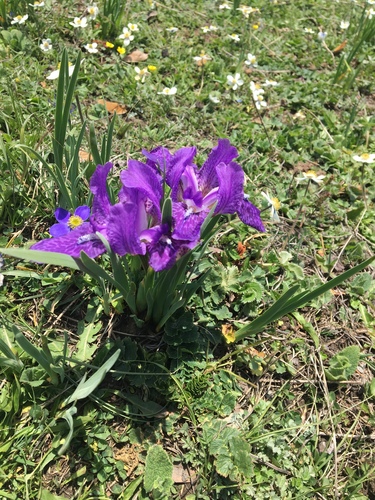
In China, Iris kemaonensis is often confused with Iris dolichosiphon, another Pseudoregelia iris. The two species have similar flower forms, but Iris kemaonensis has paler, strongly mottled flowers and a smaller perianth tube than Iris dolichosiphon. It produces short, thick, gnarled and knobbly rhizomes, with thin, fleshy secondary roots that can grow up to 10 cm long underneath. The plant does not produce stolons. Fibrous remains of the previous season's leaves sit on top of the rhizome. Its leaves are variable in size: at blooming time, they grow 6–20 cm long and 0.2–1 cm wide. Before the plant develops fruit or seed capsules, the leaves extend to 34–45 cm long, becoming taller than the flowers. The leaves are light green, greyish green, or yellowish green, glaucous, linear, and have a rounded apex. In mild climates, it is semi-evergreen, and is generally deciduous elsewhere. It has a slender, short stem that reaches 5–12 cm tall. The stem bears 2 to 3 green, lanceolate, scarious membranous spathes (flower bud leaves), which measure 5–6 cm long and 1–1.8 cm wide. The spathes are scarious, with acuminate pointed tips, and can sheath or cover the base of the stem. The stem holds 1 or 2 terminal flowers that bloom in late spring: between May and June in the UK and Europe, and between April and July in India. The scented flowers are 4–8 cm in diameter, and come in purple shades ranging from lilac to lilac-purple to pale purple. They are spotted or blotched with dark colour, and mottled like reptile skin. The flower shape is very similar to Iris hookeriana, while the flower shade is similar to Iris kashmiriana. It has 2 pairs of petals: 3 large outer sepals called 'falls', and 3 smaller inner petals or tepals called 'standards'. The falls are spatulate (spoon-shaped) or obovate, 3.5–5 cm long and 1.5 cm wide, with ovate blades. In the centre of the fall is a dense beard of white hairs with yellow or orange tips. The upright standards are oblanceolate, elliptic, or obovate shaped, 4–5 cm long and 1 cm wide, and are paler than the falls. It has 1 to 1.5 cm long pedicels, and a trumpet-shaped perianth tube 5–7.5 cm long, which is longer than the spathe. It has 2.5–3.2 cm long, 5–6 mm wide style branches, which are dark in the centre and paler at the edges, with small triangular crests. It also has 2–2.3 cm long stamens, a 6 cm long ovary, blue filaments, lavender anthers, and white pollen. After flowering, it produces a globose seed capsule 2–2.5 cm long and 1.5–1.8 cm wide. The capsule has a short beak, tapers to a pointed apex, and splits open laterally to release seeds. Inside the capsule are pyriform, reddish brown seeds with a milky yellow or cream aril (appendage). The seed capsule grows on stems that reach around 45 cm long, above the height of the leaves; this growth habit is similar to that of the Algerian Iris (Iris unguicularis). Iris kemaonensis is native to temperate and tropical regions of Asia. In temperate Asia, it is found in Tibet (Xizang), Sichuan, and Yunnan provinces of China. In tropical Asia, it occurs in Bhutan, Nepal, India, and is also naturalized in Myanmar (Burma). Within India, it can be found in Himachal Pradesh (including on the slopes of Lahul growing alongside Caltha palustris and Pedicularis punctata), Jammu, Kashmir, Uttar Pradesh, and Uttarakhand (including the former districts of Kumaon (Kemaon) and Garhwal). It grows across the Himalayas, including on Rajrambha, a Himalayan peak. Note that specimens previously identified as Iris kemaonensis in Kashmir have been reclassified as Iris hookeriana, another Pseudoregelia iris. It grows on alpine pastures, meadows, and slopes, at altitudes between 2,800 and 4,500 m above sea level. Like many other irises, most parts of Iris kemaonensis (including the rhizome and leaves) are poisonous, containing the chemicals irisin and iridin. Accidental ingestion can cause stomach pain and vomiting, and handling the plant may trigger skin irritation or an allergic reaction. It is hardy to European Zone H3, meaning it tolerates temperatures between −10 and −15 °C (14 to 5 °F). It prefers well-drained soils with a pH between 6 and 7.5 or higher, and can tolerate alkaline soils and soils containing limestone. It tolerates both dry and moist soils, and can withstand drought. It prefers full sun, but can tolerate partial shade. In regions where it is not hardy, it can be grown in an alpine house or bulb frame. The best planting time is between September and October, to produce flowers the following year. It is rarely damaged by browsing deer or rabbits. Its semi-evergreen foliage makes it easy to locate in winter. In Tibetan herbal medicine, the flowers, seeds, roots, and whole plant of Iris kemaonensis are used for different treatments. The flowers have an acrid taste, and are analgesic and ophthalmic; they are used to treat tinnitus and impaired eyesight. The seeds also have an acrid taste, are analgesic, anthelmintic, and vermifuge; they are used to treat colic pain caused by intestinal worms, hot and cold disorders of the stomach and intestines, and pain below the neck and shoulders. In Tibet, seeds are also used to treat coughs and colds. The whole plant and roots are stomachic, and can be used to treat scabies and urticaria. The roots and leaves are diuretic, and used to treat bronchitis, dropsy, and various liver complaints; when ground into powder, they are used to treat sores and pimples. Roots are also used to treat urinary disorders and kidney troubles. In India, the plant is also used as a spasmolytic and febrifuge, and as an antidote for opium addiction.