About Iris iberica Steven
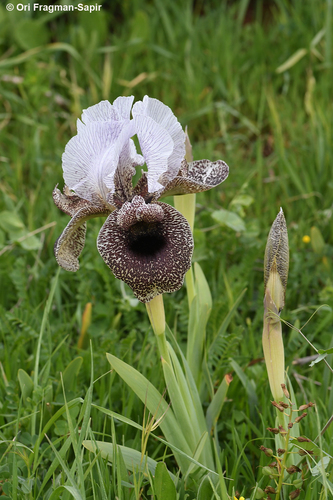
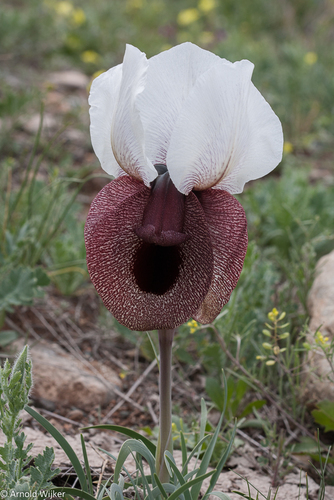
Iris iberica Steven is similar to Iris susiana, differing only in the shape of its leaves and flowers. It is classified as either a meso-xerophyte (thriving in intermediate dry conditions) or a xeric species, growing alongside other drought-adapted plants including Seseli grandivittatum, Thymus tiflisiensis, Scorzonera eriosperma and Tulipa eichleri. This species has a slender, compact, non-stoloniferous rhizome that reaches up to 1.5 cm in diameter. It produces 4 to 6 glaucous grey-green leaves, which are falcate (sickle-shaped) or curved. These narrow leaves grow between 7.5 and 15 cm (3 and 6 inches) long, and 0.2 to 0.6 cm wide. Leaf growth begins in autumn, around September, after a summer rest period that follows flowering. It has a short, slender stem (or peduncle) that reaches 15 to 20 cm (6 and 8 inches) tall. The stem bears green, lanceolate, membranous flower bud spathes that vary in size from 3 mm to 5 cm long. Each stem holds a single terminal flower at the top of the stem that blooms in late spring, between March and May; in the UK, blooming occurs later, between May and June. Flowers last 120 to 145 days before fading, and are 10–15 cm (4–6 inches) in diameter, described as large and flouncy. Flowers are very variable bi-colored forms, with a background ranging from white, silvery white, cream, or pale bluish to occasionally lilac, that is heavily dotted, spotted, or veined with pale mauve, violet, dark purple, maroon, or purple-brown. Like other irises, it has two pairs of petals: three large outer sepals called falls, and three smaller inner petals (or tepals) called standards. The falls are spoon-shaped or obovate (rounded), and either reflexed or concave. They measure 3.5–6.5 cm (1–3 inches) long, and 2.7–6.5 cm wide. In the center of the falls is a velvet-like dark signal patch, which can be deep rich purple, black-purple, brown, or blackish. In the middle of the falls runs a row of short hairs called the beard, which is brown or purplish brown. The pale standards are round or orbicular, and 4.5–10 cm (2–4 inches) long. They usually have less or paler veining than the falls. This species has style branches that match the length of the falls, are brown, 3.5–7 cm (1–3 inches) long, and have scalloped lobes. The perianth tube is 2–3.5 cm long. After flowering finishes in June, it produces a seed capsule that is 7–9 cm (3–4 inches) long, and 2–2.5 cm wide. The capsule holds 56 to 60 wrinkled seeds, each around 0.5 cm in diameter. Only 10 to 30% of the seeds are fertile. It is native to temperate Asia. Iris iberica and its subspecies have a broad distribution across the Caucasus Mountains. I. iberica subsp. elegantissima occurs in eastern Turkey, from near the Armenian border to Lake Van. I. iberica subsp. lycotis occurs in northwestern Iran near Hakkari, in Turkey near the Iranian border, and in southern Armenia near the Iranian border. The nominate I. iberica subspecies is found only in eastern Georgia near Tbilisi, Armenia, and western Azerbaijan. It grows in dry steppe grasslands or dry stony slopes in the lower mountain belt. In Georgian steppes, it grows in various spear grass communities that include Stipa pulcherrima, Stipa lessingiana, Stipa pontica and Stipa capillata, alongside scattered shrubs of red juniper and berberis. It can be found at altitudes between 400 to 700 m (1,300 to 2,300 ft), or 1,000 to 3,000 m (3,300 to 9,800 ft) above sea level. Like many other irises, most parts of the plant (especially the rhizome and leaves) are poisonous. Accidental ingestion can cause stomach pain and vomiting, and handling the plant may trigger skin irritation or an allergic reaction. Irises in the Oncocyclus Section are generally harder to grow than irises in the Regelia Section. I. iberica is hardy to European Zone 4, meaning it tolerates temperatures between −5 and −10 °C (23 to 14 °F). In parts of Europe, it can be planted in a sunny rock garden position in sandy soil, though it grows best in a cold frame or alpine house. This placement protects the iris from excess moisture, especially in winter, and ensures the shallow-planted rhizomes receive optimal temperatures during the growing season. It can be grown in pots, particularly deep pots known as 'long toms', but requires re-potting every 2 years and additional feeding. Watering is one of the most critical aspects of cultivating this iris. It can suffer from infestations of aphids, viral infections, and rots. It is also affected by the fungus Puccinia iridis. It serves as a host plant for Mononychus schoenherrii Kolenati, a weevil that feeds on the iris's seeds. The weevil lays its eggs inside the iris's seed capsule; larvae then feed on the seeds before pupating. Adult weevils emerge from the seed capsules, then fly away to undergo aestivation (summer dormancy) and hibernation. A specimen of this iris is held in the Herbarium Hookerianum at the Royal Botanic Gardens, Kew.