About Iris furcata M.Bieb.
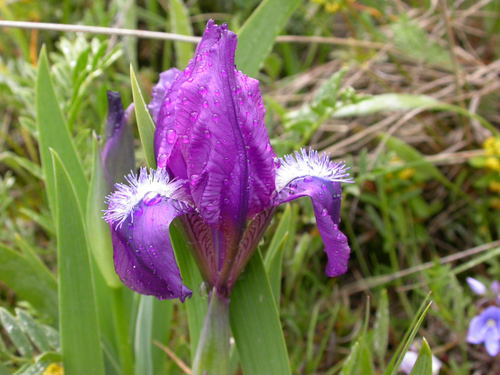
Iris furcata M.Bieb. is similar in overall form and flower color to Iris aphylla. The main difference between the two species is in their stems: Iris furcata stems branch near or above the middle, while Iris aphylla stems do not branch at all. Iris furcata has a short, creeping fibrous rhizome that measures 2 cm long and spreads across the ground surface. It produces short, linear, sword-shaped (ensiform) leaves that are more slender than those of Iris aphylla; these slender leaves grow up to 20 cm (8 in) long, between 0.5 and 1 cm wide, and are normally about 15 mm wide. The species has a slender stem, or peduncle, that reaches 15–50 cm (6–20 in) tall. The stem is shorter and more slender than that of Iris aphylla, and it usually branches above the middle of the stem. The stem holds green, inflated, ovate or oblong flower bud leaves called spathes, which sometimes have purple veins. Each stem and its branches bear flowers that bloom in early spring, or late spring and early summer, typically in May. The flowers are smaller than Iris aphylla flowers, at about 3–4 cm (1–2 in) long, and they come in shades of purple, deep purple, blue-violet, light blue or violet. Like other irises, it has 2 pairs of petals: 3 large outer sepals called 'falls' and 3 smaller inner petals or tepals called 'standards'. The falls have an obovate blade and narrow claw, with a beard in the center that has not yet been described. The standards are lanceolate in shape. It has a deltoid-shaped style branch that measures 1.2 cm long and has toothed edges. After flowering in late summer, it produces an elongated triangular seed capsule. Inside the capsule are small, reddish brown, oval, wrinkled, rather compressed seeds. The seeds measure 4-5 mm long and 2-3 mm wide, and they are smaller than the seeds of Iris aphylla; 53–56 Iris furcata seeds weigh 1 gram, while only 32–35 Iris aphylla seeds weigh 1 gram. Iris furcata is native to Eastern Europe. It can be found in the Caucasus mountains, between the Black Sea and the Caspian Sea, within Moldova, Ukraine, and the former southern Russian states. It has also been found in Lazistan, Georgia, growing alongside Iris taochia. In the Caucasus, it grows alongside other mountain flora including Anemone fasciculata, Anemone ranunculoides, Caltha polypetala, Veratrum lobelianum, Pulsatilla armena, Corydalis persica, Fritillaria caucasica, Betonica grandiflora, Prunus spinosa, Sedum pilosum, Sempervivum transcaucasicum, Malus orientalis and Pyrus caucasicus. It grows on dry open pastures, steppes, among bushes on mountain slopes, and beside woodland edges, at an altitude of around 1,500 ft (460 m) above sea level. Like many other irises, most parts of this plant (especially the rhizome and leaves) are poisonous. Accidental ingestion can cause stomach pains and vomiting, and handling the plant may lead to skin irritation or an allergic reaction. Iris furcata is cold hardy, and can tolerate growing conditions in St. Petersburg, Russia. It prefers to grow in well-drained soil, and can tolerate alkaline soils as well as peat soils. It prefers to stay dry during summer, and is prone to viral infection in damp conditions. It also prefers to be situated in light shade, and can be grown in rockeries. It is often damaged by slugs or snails. It was first cultivated in Dorpat, Russia in 1820, then grown in 1838 at the Imperial Botanical Garden of St. Petersburg, followed by cultivation in the Botanical Garden of Moscow in 1948, and later in Stavropol. It is also cultivated at the Nezahat Gökyiğit Botanic Garden in Turkey. It is mostly grown by plant collectors and iris enthusiasts.