About Iris formosana Ohwi
Iris formosana Ohwi has thick rhizomes and slender branching stolons, and grows into large clumps. It produces herbaceous, erect, rigid, sword-shaped leaves; one side of the leaf is greyish-green, the other bright green. Leaves reach 30 to 40 cm (12 to 16 in) long and 2 to 2.5 cm wide, with 3 to 5 visible veins, and are similar to the leaves of Iris japonica.
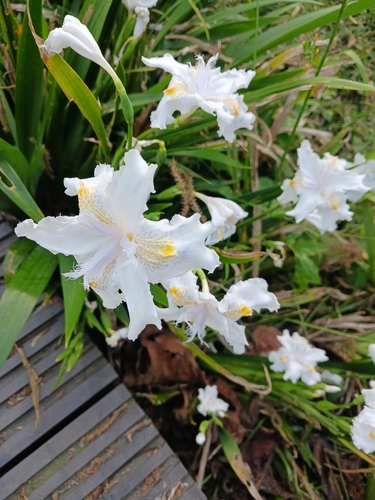
It produces a thick flowering stem that ranges from 15 to 90 cm (6 to 35 in) long, most commonly 30 to 40 cm (12 to 16 in). Stems are smaller than those of Iris confusa, and bear 4 to 5 branches. The stems hold 4–6 spathes (flower bud leaves) with membranous margins. Stems and their branches hold 3 to 5 flowers that bloom in spring: April to May in the UK, or March to April in Europe. The flowers resemble those of Iris japonica, but have shorter basal leaves and larger white blooms. Flower diameter ranges from 7–10 cm (3–4 in), and blooms can be white, lilac, light purple, lavender, or pale blue.
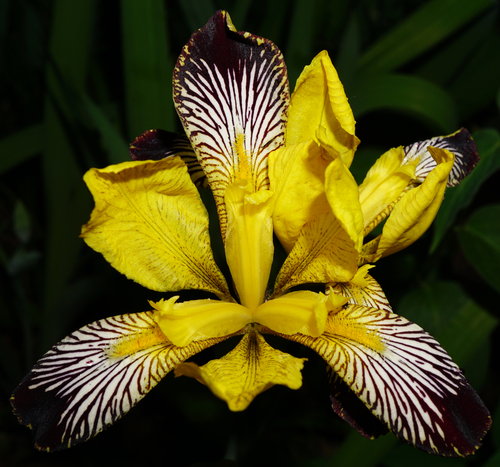
Like other irises, it has 2 pairs of petals: 3 large outer sepals called 'falls', and 3 smaller inner petals (or tepals) called 'standards'. The falls are obovate, 4–5 cm long and 2.5 cm wide, with blue markings, yellow-brown, purple, or mauve spots surrounding a large yellow or orange crest, and wavy, serrated or denticulated (toothed) margins. The standards are obliquely reflexed, shaped oblanceolate to oblong, 2.5–3 cm long and 1.5 cm wide, with a furrowed apex. It has a 1 cm long white perianth tube, oblong to linear anthers 8–9 mm long, 1.5 cm long white filaments, and a 1 cm long ovary. It also has pale blue or white style branches 2 cm long and 6–7 mm wide, with a fimbriate (fringed) lobe. This species is self-sterile. After flowering, it produces an oblong-ovate seed capsule 3–4 cm long, with the remains of the perianth tube on the capsule's apex.
Iris formosana is native to temperate Asia, and specifically found in northeastern Taiwan. It grows at forest margins, on hillsides, steep cliffs, and beside roadsides, at low to mid-elevation mountain altitudes between 500 and 1,000 m (1,600 and 3,300 ft) above sea level.
It is not hardy in northern climates and cannot tolerate frosts, with a hardiness rating of USDA Zone 8 or 9 (tolerating temperatures between −6 °C and −1 °C). Because it is not hardy in the UK, it is uncommon in cultivation. It prefers to grow in humus-rich, well-drained soils, and can tolerate a range of soil types including calcareous or siliceous soils, and neutral or acidic soils with a pH between 6.5 and 7.5. It grows best in shade or partial shade, and requires moist conditions and medium to high humidity during the growing season. Overwatering or excess winter water can kill the plant. It can be grown in mixed flower borders, as a ground cover, or in containers in sheltered positions, and may be damaged by slugs and snails.