About Iris ensata Thunb.
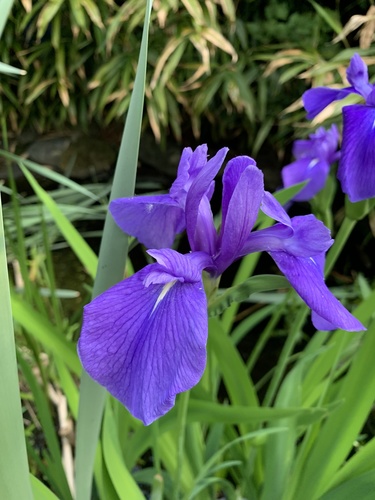
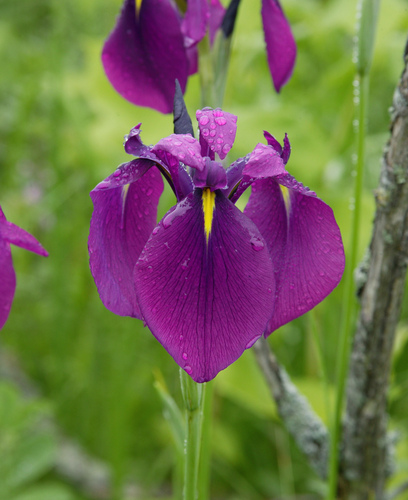
Iris ensata Thunb. is an erect, rhizomatous herbaceous perennial that grows up to 80 cm (31 in) tall, and produces strap-shaped leaves. Its flowers bloom in midsummer; they are purple with a yellow marking on the falls, and their bluish purple flower colour is an example of the copigmentation phenomenon. This species is widely distributed across the Japanese archipelago and other regions. It is very hardy, tolerating temperatures as low as −20 °C (−4 °F). It grows best in boggy or marshy environments and acidic, low-pH soil, and will eventually form large clumps when grown in favourable conditions. Iris ensata is widely grown as an ornamental plant in gardens and parks across temperate regions of the world. It is highly valued in Japan, where it may have been introduced into Japanese culture in ancient times linked to rice farming. It has been cultivated and hybridized in Japan for at least five centuries. The cultivated variety hanashōbu, botanically classified as Iris ensata var. ensata (with synonyms I. ensata var. hortensis and I. kaempferi), grows in wetland and is the most widely cultivated variety in Japanese gardens. Iris ensata is divided into three cultivar groups based on their region of cultivation in Japan: Edo (from Tokyo), Higo (from Kumamoto Prefecture), and Ise (from Mie Prefecture). After this species was introduced to Western countries in the mid-19th century, a new era of cultivation for Iris ensata began. It was intensively hybridized in America to create many new cultivars. The most influential American breeders have been Arlie Payne of Indiana, the Marx family of Oregon, Arthur Hazzard of Michigan, and Currier McEwan of Maine; together, these breeders developed cultivars with large blooms and a broad range of flower colours. Interest in Iris ensata is equally strong in the United Kingdom, where the national collection of the species is held at Marwood Hill Gardens in Barnstaple, Devon. A number of its cultivars have received the Royal Horticultural Society's Award of Garden Merit.