About Irena puella (Latham, 1790)
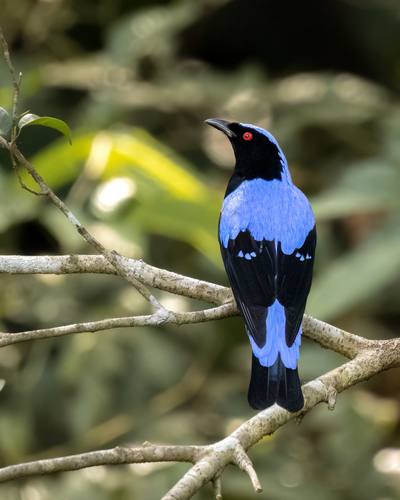
This species is the Asian fairy bluebird, with the scientific name Irena puella (Latham, 1790). The Asian fairy bluebird measures 24 to 27 cm (9.4 to 10.6 in) in length. It has a crimson iris and pinkish eyelids; its bill, legs and claws are black, and its mouth is flesh-coloured. This species shows marked sexual dimorphism. The male has shining ultramarine-blue plumage with lilac reflections on its upper body, lesser wing coverts, and under tail coverts. The sides of its head and its entire lower plumage are deep black; its greater wing-coverts, flight quills, and tail are black. Some of the coverts are tipped with blue, and the middle tail-feathers have a blue gloss. For the female, the upper plumage, lesser wing coverts, and lower tail coverts are brownish blue, with brighter feather edges. The middle tail feathers and the outer webs of all other tail feathers except the outer pair match the colour of the female's upper plumage; the rest of the tail is dark brown. The female's primaries and secondaries are dark brown. Her greater wing coverts, primary coverts, and tertiaries are dark brown, with a blue tinge on the outer webs. The sides of the female's head and her entire lower plumage are blue, very similar in colour to her upper parts. Young birds resemble adult females. Young males change into adult plumage in March, and this change occurs without a moult. The feathers of the upper parts first develop bright blue fringes, then the tail coverts change colour, and finally the lower plumage changes. Young birds with lower plumage mixed between black and dull blue, and upper plumage matching that of adult males, are frequently seen. Several subspecies exist, including I. cyanea malayensis from the Malay Peninsula; males of this subspecies differ by having longer undertail coverts that nearly reach the tip of the tail. The subspecies previously recorded from Palawan is now considered a separate species, the Palawan fairy-bluebird (I. tweeddalii). The Asian fairy bluebird's distribution includes Sri Lanka, the western coast of India from Travancore north to the latitude of Shivamogga, Belgaum and Sawantwadi, Sikkim, the lower ranges of the Himalayas to Dibrugarh in Assam, the Khasi Hills, Cachar, Manipur, Bangladesh, Arrakan, Bago and Taninthayi Division in Burma, and the Andaman and Nicobar Islands. In southeast Asia it occurs across most of Indochina, including Peninsular Malaysia, as well as Sumatra, Borneo, Java, and smaller nearby islands. In the Indian portion of its range, the species is restricted to evergreen forests of hills and plains. Elsewhere it is regularly found in various types of humid and deciduous forests, from lowlands up to around 1,600 metres (5,200 ft). The species is reported to be more common in mature rainforests and in rustic cardamom plantations grown under native shade trees than in coffee plantations. Within the areas it occupies, this bird is common, and typically moves in small parties or in pairs.

