About Irediparra gallinacea (Temminck, 1828)
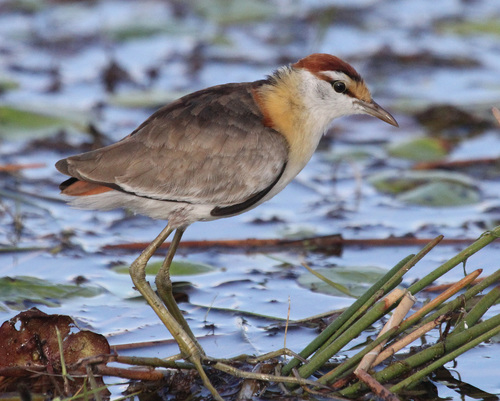
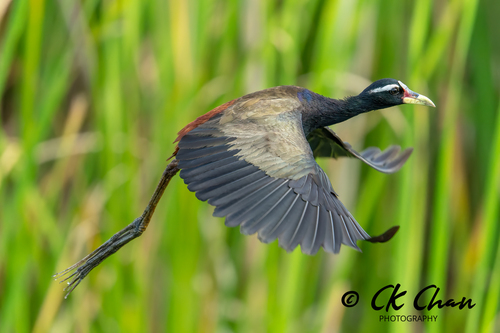
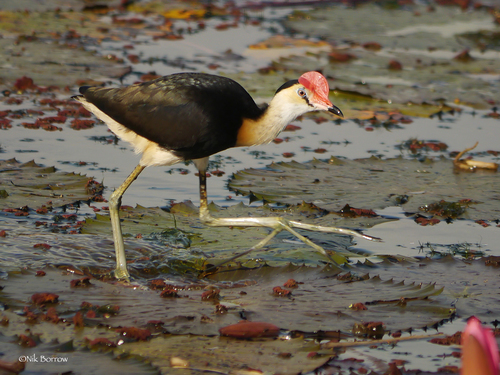
Irediparra gallinacea is an easily recognizable species. It has a black crown and black hindneck, with a fleshy red wattle that covers the forehead and forecrown. This wattle contrasts sharply with the bird's white face and white throat. The comb of the species is pinker in breeding adults, and more orange in non-breeding individuals. The species has a broad black band across its lower breast, and a white belly. Its underwing and flight feathers, which are most visible during flight, are black. The back and upperwing are mainly grey-brown, with black primary coverts, rump and tail. The bird has long legs with extremely long toes that trail behind it during flight. Males are slightly smaller than females: males measure 20–22 cm (7.9–8.7 in) in length and weigh 68–84 g (2.4–3.0 oz), while females measure 24–27 cm (9.4–10.6 in) in length and weigh 120–150 g (4.2–5.3 oz). The species' wingspan ranges from 39 to 46 cm (15 to 18 in). This bird is found in south-eastern Borneo, the southern Philippines, Sulawesi, the Moluccas, the Lesser Sunda Islands, northern and south-eastern New Guinea, New Britain (Lake Lalili), and northern and eastern Australia. It inhabits large freshwater wetlands, swamps and lakes that have abundant floating vegetation such as water-lilies or water hyacinth. This vegetation forms a mat on the water surface that the bird is able to walk on. While the species is rare and has a localised distribution, it is not globally threatened.