About Ircinia strobilina (Lamarck, 1816)
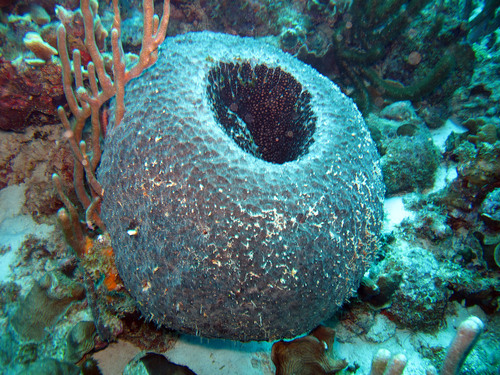
Ircinia strobilina (Lamarck, 1816) is a species of sponge belonging to the family Irciniidae. Its body is grey or shiny black, and its surface is dotted with small spiny structures called conules. These spiny structures connect to one another via ridges, and do not form an ordered regular lattice. This species has a globular, massive, lobed and spherical shape, and typically reaches no more than 0.3 metres (1 foot) across. It has a tough, firm texture. Its large excurrent (outflow) pores sit in depressions on the top of the sponge, while many smaller incurrent (inflow) pores are scattered across the body surface, with denser concentrations on the sides. Ircinia strobilina lives in marine habitats, specifically in the Caribbean Sea, including waters off the coasts of Florida, the Virgin Islands, Cuba, and Venezuela. It occurs in warm, shallow water, where it anchors itself to a solid substrate. It is the most abundant sponge species on the Abrolhos reef, where it grows in areas exposed to many predatory fish, which generally avoid this sponge. Ircinia strobilina uses chemical defenses to repel fish predation. In a study of three sponge species that involved force-feeding this sponge to the fish Holacanthus tricolor, the fish became temporarily paralysed and lost its balance. The chemicals responsible for repelling predators have been extracted and identified: variabilin, a metabolite that is also a sesterterpene, and its isomer strobilin. The same study also found that Ircinia strobilina forms scar tissue to repair lesions faster than the two other sponge species included in the study: Neofibularia nolitangere and Agelas clathrodes.

