About Iraota timoleon (Stoll, 1790)
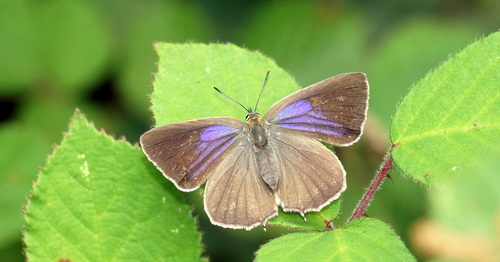
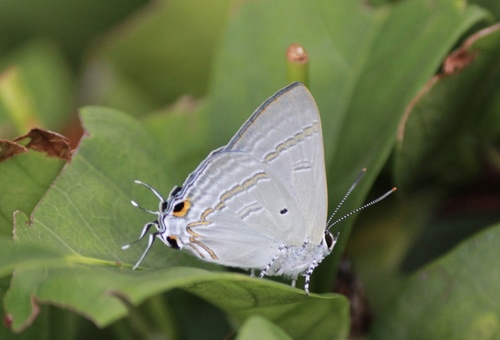
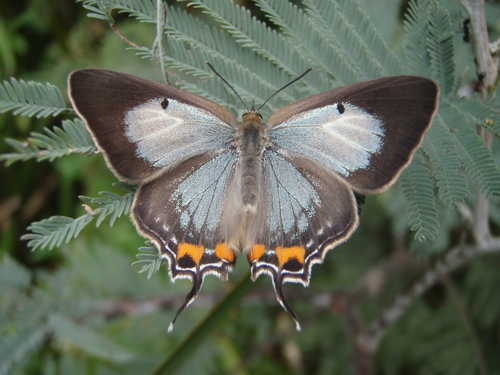
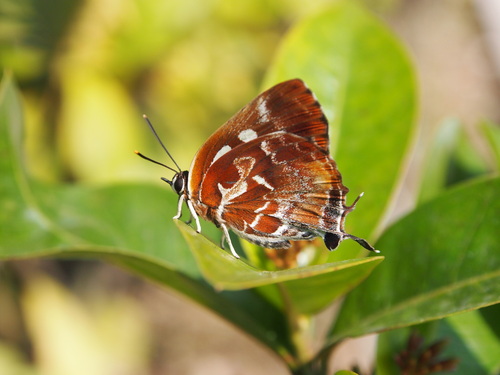
Male description: Upperside. Forewing is black, with the basal two-thirds of the lower wing area covered in deep metallic blue; the blue area varies in extent across different specimens. Hindwing is also black, with the disc covered in deep metallic blue that also varies in extent. The abdominal marginal space is pale, and a glandular basal patch sits between veins 7 and 8. The tail is black and tipped with white. Cilia on both wings are black and tipped with white. Underside is variegated dark chocolate brown, with paler sections in some areas. Forewing has a gradually formed club-shaped silvery streak inside the cell, touching the sub-costal nervure, and extending slightly beyond the middle of the cell. There is a round silvery spot at the end of the cell, and a discal series of four spots arranged in a straight line in pairs: the upper two lie below the costa, and the other two lie in the middle of the disc. The upper and lower portions of the wing are paler than the central portion. Hindwing has a very prominent, curiously shaped silvery band. This band extends from the base, where it is narrow, suddenly broadens, has an upward-pointing projection and a downward lobe, then narrows slightly, turns upward, and expands into a large lobe near the middle of the costa. A small silvery spot sits below the band. Two angulated, outwardly curved, indistinct pale whitish lines run from the abdominal margin across the wing: one ante-medial and one post-medial. There are also indistinct whitish terminal and sub-terminal lines. The anal lobe is black, and a long somewhat spatulate tail, black with a white tip, sits at the end of the internal vein. Antennae are black, with pale orange-red tips. The head and body are black above and brown beneath. The palpi are white beneath, and the eyes are ringed with white. Female description: Upperside colour varies from purplish-brown to bright shining blue, with black borders that vary greatly in width across different specimens. Underside matches the male, but all markings are larger and more prominent. A medium-sized filamentous tail is present at the end of vein 2, in addition to the tail at the anal lobe.