About Irania gutturalis (Guerin-Meneville, 1843)
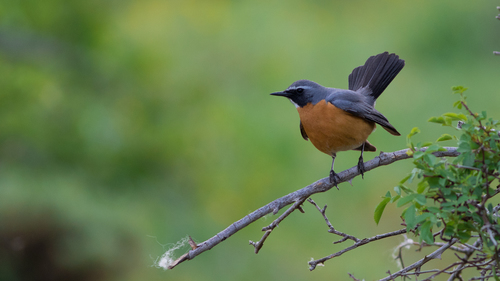
This species, the white-throated robin (Irania gutturalis), is larger than the European robin, measuring 16 centimetres (6.3 in) in length with a 28 centimetre (11 in) wingspan. Breeding males have lead-grey upperparts, a black face, a white throat and supercilium, and orange underparts. Both the tail and the strong bill are black. Females have plainer plumage: they are mostly grey with a black tail, faint orange on the flanks, and some streaking on the white throat. The male’s song is fast twittering, produced from a bush or during flight. The species’ call is a double chis-it note, similar to the call of the white wagtail. The white-throated robin is a migratory species. It breeds across western Asia from Turkey to Afghanistan, and winters in East Africa. During the winter, it occurs in closed thickets in dry areas, most commonly in Acacia-Commiphora woodland on East Africa’s dry central plateau. Small numbers reach as far south as the Usangu Plains of Ruaha National Park, Tanzania, which is the species’ typical southern winter limit. In dry years, some individuals may move even further south, reaching moister uplands at 1,600 metres above sea level. The species is also a very rare vagrant to Europe, with recorded observations as far northwest as Norway, the United Kingdom, and Sweden. The white-throated robin’s main breeding habitat is dry rocky slopes dominated by scrub, most often at high altitudes between 1,000 metres (3,300 ft) and 2,200 metres (7,200 ft) above sea level. It also breeds in other habitats including semi-desert, mountain steppes, and less arid sites such as ravines that contain mountain streams.