About Ipomoea pubescens Lam.
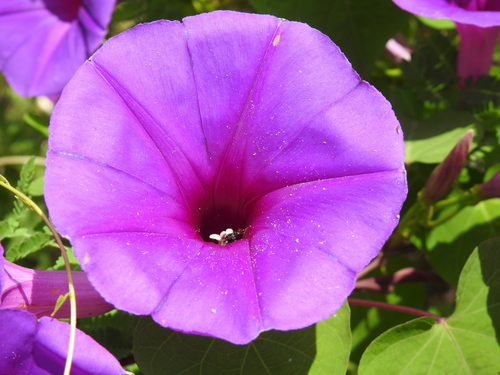
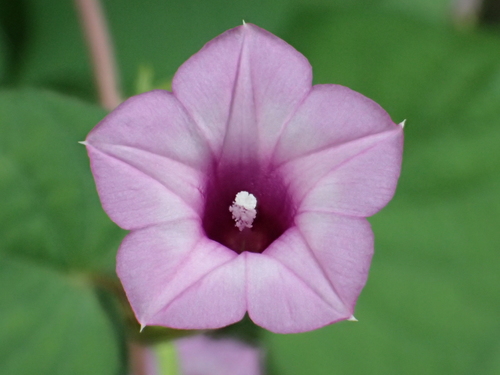
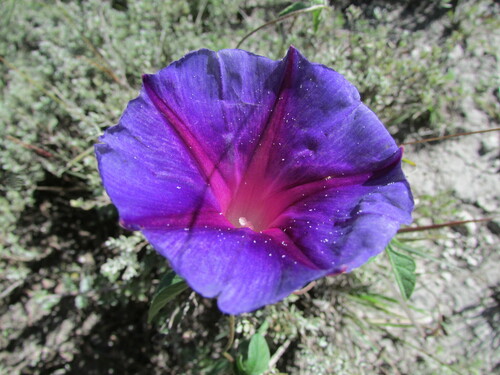
Ipomoea pubescens Lam. is a herbaceous, perennial twining vine with a relatively large root. Its leaves are egg-shaped, 3-5-lobed, with cordate bases, growing up to 8 cm (~3 inches) long and 9 cm (3½ inches) wide. Leaves are covered in relatively long hairs that sometimes have a silky texture. This species produces blue to violet funnel-shaped corollas that reach up to 8 cm (~3 inches) long and 7 cm (2¾ inches) wide. Research-grade observations of Ipomoea pubescens on iNaturalist map show the species grows in two separate, disjunct regions. In the north, its range extends from mountainous southwestern United States (Arizona, New Mexico, and Texas) south through the Mexican highlands into Oaxaca state. The species is apparently absent from Central America, and reappears in mountainous western South America from Colombia south to northern Argentina. In the United States, this species (also called silky morning glory) grows on rocky sites, in stream beds, and in oak woodlands, at elevations between 100 and 1600m (~330–5240 ft). In Mexico, it occurs in semi-arid scrub, oak and pine forests, and tropical deciduous forests, at elevations between 1450 and 2500m (~4750–8200 ft). In South America, Argentina records the species from three areas: the Yungas bioregion, a warm, forested area along the eastern slope of the Andes Mountains; the Argentine Monte, a dry ecoregion of thorn scrub and grassland; and the Prepuna, a region of dry, mountainous ravines in northwestern Argentina. In Argentina, it grows between 1500 and 2000m (~4900–6600 ft). Traditionally in the Andes, the roots of Ipomoea pubescens have been eaten raw. Francisco Hernández de Toledo recorded historical medicinal use of this species in Mexico in the classic text Historia de las Plantas de la Nueva España, written after his 1571-1576 exploration of the region. The text notes that the root, described as having warm properties and a pleasant taste, when crushed and taken as a one-ounce dose with water, purges all humors through the lower intestinal duct without causing harm or discomfort.