About Ipomoea pes-caprae (L.) R.Br.
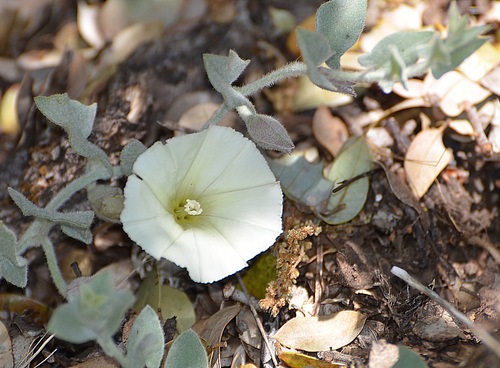
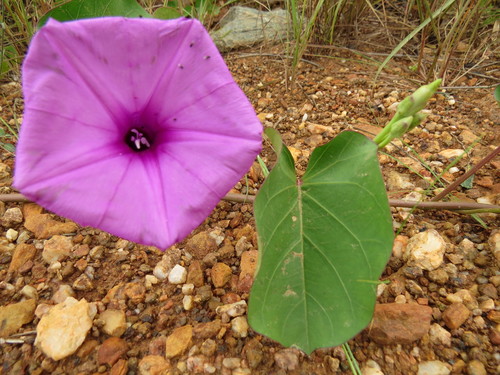
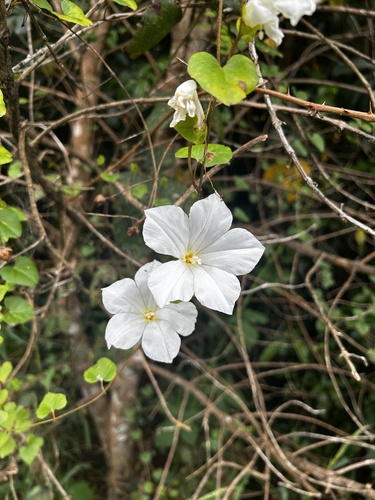
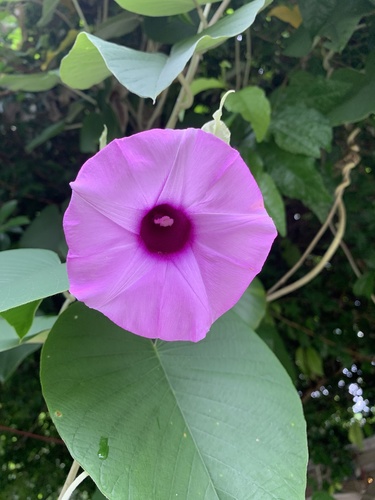
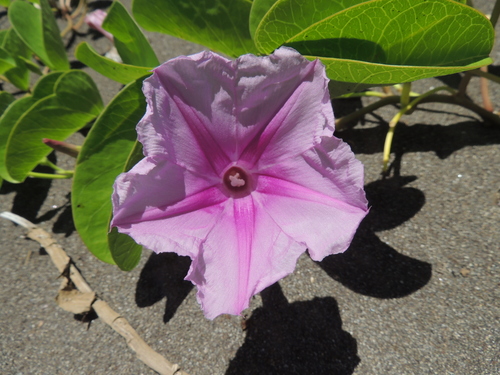
Ipomoea pes-caprae (L.) R.Br., commonly called Goat's Foot, is a prostrate perennial vine that often spreads to cover large areas. It has long trailing stems that are usually several metres long, and rarely reach up to thirty metres; the stems root at their nodes and are glabrous. Its flowers have fused pink petals with a darker centre. It produces a capsule fruit containing four hairy seeds that can float on water. This species grows on the sandy shores of the tropical Atlantic, Pacific, and Indian Oceans. In Australia, it is common on the sand dunes of the upper north coast of New South Wales, and can also be found along Queensland's entire coastline. It is a primary sand stabilizer, and is one of the first plants to colonize dunes. While it can grow across almost all parts of dunes, it is most often found on seaward dune slopes, sending long runners down toward the toe of the dune. Its sprawling runners spread out from a woody rootstock, but its large two-lobed leaves are sparse; dense sand coverage is rarely achieved except in protected growing environments. It grows in association with sand Spinifex grass, acts as a useful sand binder, and thrives in conditions with sandblast and salt spray. Ipomoea pes-caprae has been recorded growing in community with other tough dune-adapted species, and its ability to endure difficult dune growing conditions has been studied alongside these species: Hydrocotyle bonariensis, Senecio crassiflorus, and Juncus acutus. Along with Wollastonia biflora, Portulaca oleracea, and Digitaria ciliaris, Ipomoea pes-caprae is typically one of the first species to colonize degraded or altered environments in tropical zones of the world. A similar species, Ipomoea imperati, has white flowers and an even wider distribution across the world's beaches. In terms of uses, in Australia, it is commonly used as an Aboriginal medicine, applied as a poultice for stings from sting rays and stone fish. In Brazil, the subspecies brasiliensis, known locally as salsa-da-praia in folk medicine, is used to treat inflammation and gastrointestinal disorders. In the Philippines, the plant is known locally as Bagasua, and is used to treat rheumatism, colic, oedema, whitlow, and piles.