About Ipomoea pandurata (L.) G.Mey.
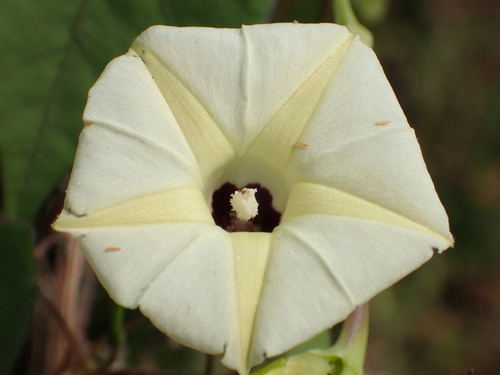
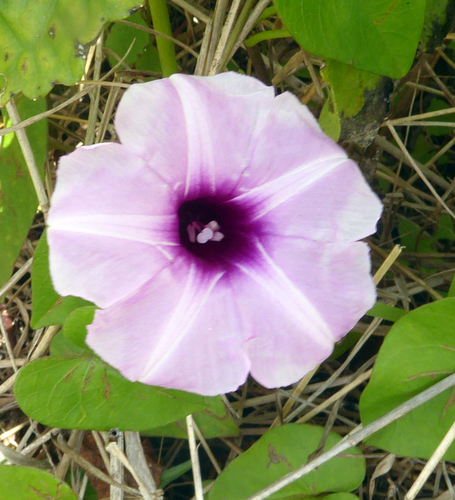
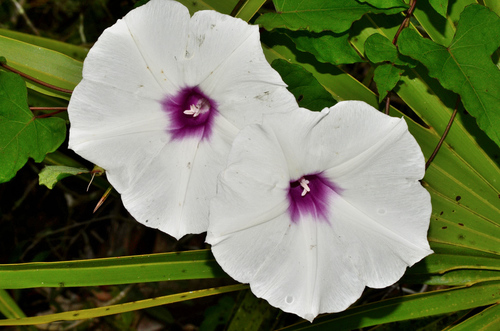
Ipomoea pandurata (L.) G.Mey. is a twining and scrambling vine that can grow up to 30 feet (9 meters) long. Its stems are typically hairless, and it bears alternate, olive-green, heart-shaped (cordate) leaves that reach around 6 inches (15 cm) in length, attached to long, purple-tinged petioles. Flowers develop in the leaf axils in groups of one to five blooms. The flower sepals are light green, hairless, and overlapping. The flowers have a tubular shape, are white overall with a pinkish or purplish center throat, and the five-lobed corolla measures 2.5 to 3 inches (6.4 to 7.6 cm) in both length and width. The stamens form a white rounded cluster in the center of the throat. Flowers open overnight and close around mid-day on sunny days, though they last longer when the weather is cloudy. After flowering, the plant produces seed capsules that hold two to four flat seeds, which have distinct hairs along their outer edges. The native range of Ipomoea pandurata covers the southern and eastern regions of the United States, and extends north into Ontario, Canada. It grows in a variety of habitats including upland woods, edges of prairies adjacent to woodlands, thickets, rocky gullies, stream-sides, disturbed ground, and railway and highway verges. Long-tongued bees including honey bees, bumblebees, and digger bees visit Ipomoea pandurata to collect nectar, along with various species of butterflies and moths. Multiple types of tortoise beetles (subfamily Cassidinae) and the sweet potato leaf beetle (Typophorus nigritus) feed on this plant's leaves. The larvae of both these beetle groups feed on the plant's swollen tuberous roots, while the larvae of the sweet potato leaf miner moth (Bedellia somnulentella), morning-glory plume moth (Emmelina monodactyla), and sweetpotato hornworm (Agrius cingulata) feed on the foliage. Mammalian herbivores avoid this plant, as it has a bitter taste and is somewhat toxic. Ipomoea pandurata produces a large edible tuber from its root, which can grow up to 75 cm (30 in) long, 12 cm (5 in) thick, and weigh as much as 10 kg (22 lb); some sources report even larger tubers. The tuber can be roasted and eaten, with a flavor and texture similar to sweet potato. Young tubers are considered the best for eating, as older tubers may become bitter. Other uses for the plant include making a poultice from the roots to relieve pain in rheumatic joints. An infusion prepared from the roots is also reported to have expectorant, diuretic, and laxative effects.