About Ipomoea nil (L.) Roth
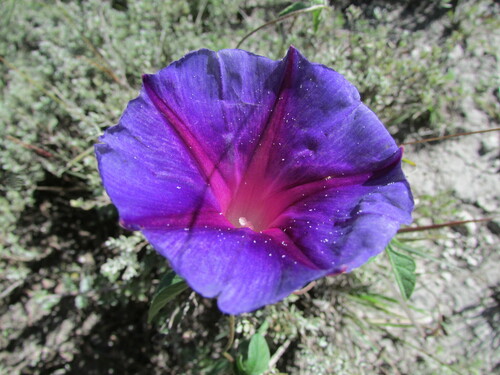
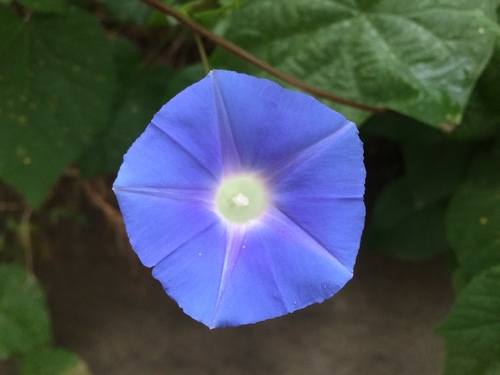
Ipomoea nil (L.) Roth is native to Central America and Mexico. It is a climbing vine with twining stems that can reach up to 5 meters in length; stems are densely to sparsely covered in long hairy trichomes. Its finely hairy, emerald green leaves range from ovate to nearly circular in shape, measuring 5 to 14 cm long, with heart-shaped bases. Leaf margins are either smooth or divided into 3 to 5 lobes, and the lobes have pointed, tapering tips. This species, particularly its wild form, is extremely similar in appearance to Ipomoea hederacea. Its funnel-shaped, colorful flowers, which range from blue to reddish-purple with a whitish inner tube, are quite showy. Flowers are borne in often dense cymose groups, with up to five individual flowers per group, where fully open flowers and developing buds occur together. Wild Ipomoea nil plants produce smaller flowers than cultivated forms, and wild flowers are almost always blue, while cultivated forms have a wide range of flower colors. Flowers open in the morning and close by the afternoon. The sepals are long, thorny and hairy, 15 to 25 mm long; they are broadly lanceolate, with linear-lanceolate pointed tips. The corolla can be blue, purple, or nearly scarlet red, and its throat is often white. The corolla tube measures 3 to 5 cm long, and the open corolla face has a width of 4 to 5 cm. Fruits are nearly spherical to spherical capsules, 8 to 12 mm in diameter. Seeds are pear-shaped and densely covered with short trichomes. Ipomoea nil is cultivated as an ornamental plant in many regions, and descendants of escaped garden plants now grow in the wild. It is fast-growing and self-seeding. It can be used to cover unsightly fences or walls, and grown decoratively on trellises. Flowers are several centimeters wide, and come in various shades of blue, pink, or rose, often with white stripes, white edges, or blended color patterns. Common cultivars include 'Scarlet O'Hara', 'Early Call', and 'Rose Silk'. Hybrids have been developed, most commonly with Ipomoea purpurea. Some of these hybrids have been given the unofficial name Ipomoea x imperialis, also called Imperial Japanese morning glory; one cultivar of this group is 'Sunrise Serenade'. Other alternative names used for these hybrids include Ipomoea nil x imperialis, for the cultivar 'Cameo Elegance', and Ipomoea nil 'Imperialis'. In colder regions, or when grown in shaded garden locations, it is a frost-tender annual. When well-managed and grown in full sun over winter, it can be maintained as a perennial.