About Ipomoea leptophylla Torr.
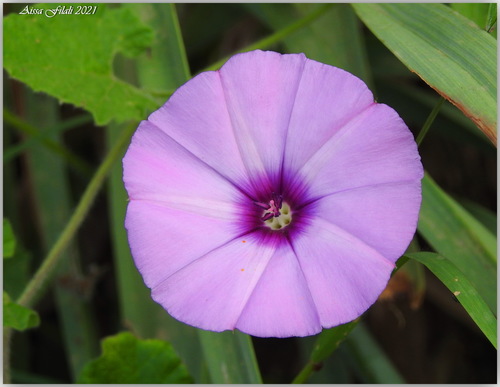
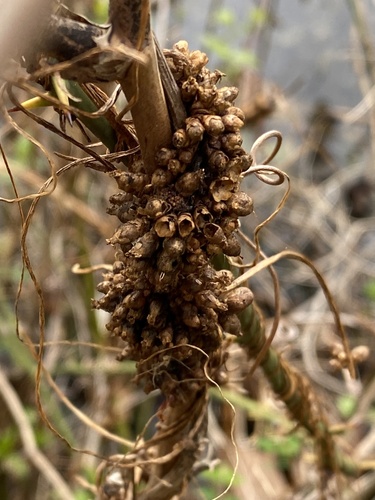
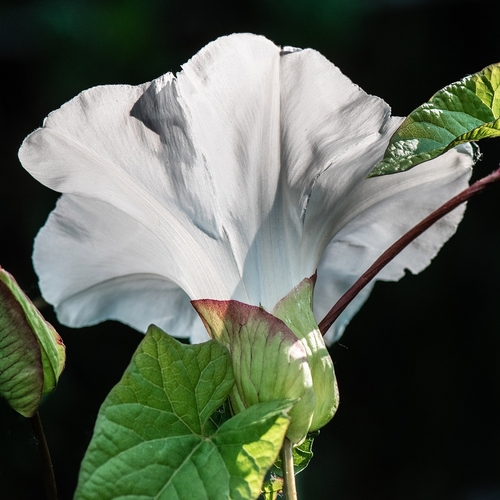
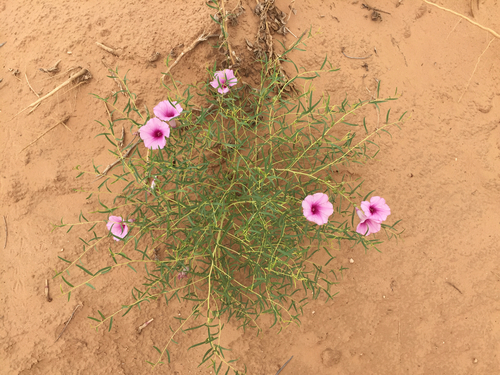
Ipomoea leptophylla Torr. is a long-lived herbaceous plant. All of its aboveground parts die back after the first frost, and new spring shoots emerge quite late in the season. It produces a large spindle-shaped tuber that grows at least 50 centimeters below the soil surface; this tuber can reach 50 centimeters in diameter and weigh up to 6 kilograms. Up to six stems grow from the top of the tuber, all within an area of one quarter of a square meter. The stems are hairless with a smooth texture, and they can grow either upright or trail a short distance along the ground, reaching about one meter in total length. Its leaves are narrow, have smooth untoothed edges, and end in a sharp point. Flowering occurs between May and July. The flowers are large, funnel-shaped, and range in color from purple to pink. Each flowering peduncle holds one to four flowers connected by short pedicel stems. The flower diameter measures 4.5–7 cm, and the flower tube length measures 5.5–7 cm. Extrafloral nectaries are located at the base of the pedicels. The seeds are large, oblong, and measure 10 mm long by 4 mm wide; each seed can weigh up to 0.1 gram, and has a fine downy surface. Ipomoea leptophylla grows in sandy locations across the American Great Plains. It is the only widespread prairie species in the genus Ipomoea, though other species in the genus are adapted to grassland habitats. Its range extends from Texas in the south, through the plains states, to South Dakota and Montana in the north. Commonly called bush morning glory, Ipomoea leptophylla is sometimes cultivated in xeric or native plant gardens, valued for its abundant flowers and long blooming season. It is typically grown from seed, because its large deep root can only be moved successfully when the plant is dormant. For germination, seeds require either cold, moist stratification, or mechanical nicking or filing followed by an overnight soak in water. Seedlings only emerge once the soil has become very warm, and any frost will kill the young seedlings.