About Ipomoea lacunosa L.
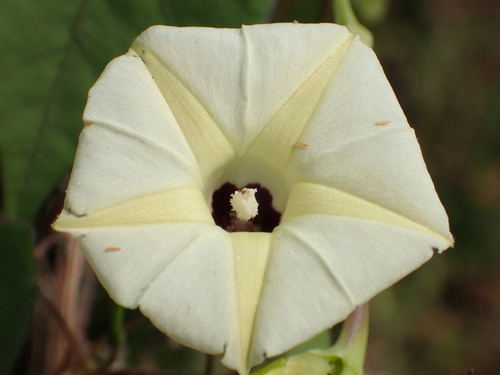
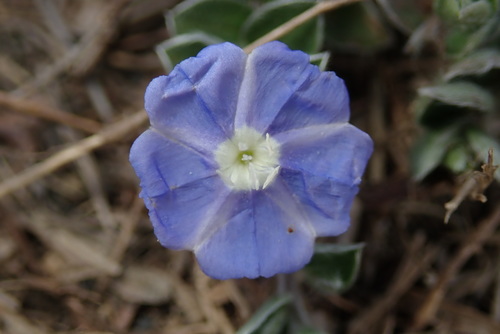
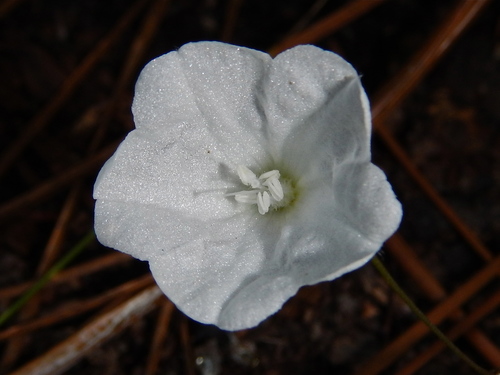
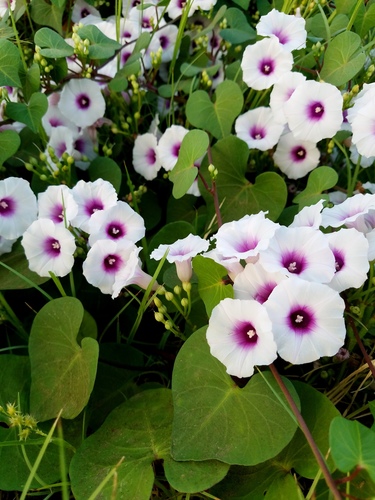
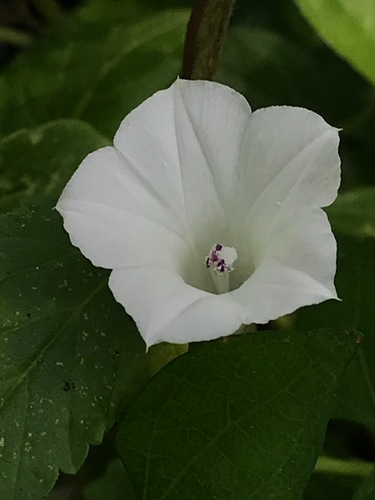
Ipomoea lacunosa L. has a slightly hairy twisting, climbing, and twining vine stem with fine white hairs, and reaches up to 2 meters in total length. It has a small taproot alongside additional fibrous roots, and relies on its vining growth habit for dispersal. Mature individuals bear cordate leaves with pointed tips, though leaves sometimes develop three deep lobes; leaves on younger, less mature plants are usually ovate. All leaves are arranged alternately along the stem. Slender petioles are typically at least 3 centimeters long, with a shallow groove along their upper adaxial surface. Full-grown leaf blades can grow up to 8 centimeters wide and 9.4 centimeters long. Leaf margins are usually smooth and distinctly purple, and the upper leaf surface may bear a sparse covering of fine white hairs. This species is native to the United States, where it occurs across much of the country. It is found in nearly every state along the East Coast, plus several Midwestern states and California; confirmed locations include Alabama, Arkansas, California, Washington D.C., Delaware, Florida, Georgia, Iowa, Illinois, Indiana, Kansas, Kentucky, Louisiana, Massachusetts, Maryland, Montana, Mississippi, North Carolina, New Jersey, New York, Ohio, Oklahoma, Pennsylvania, South Carolina, Tennessee, Texas, Virginia, and West Virginia. It has also been introduced to Canada, where it grows successfully in the province of Ontario. While it grows rapidly, it has a much lower tendency to become invasive than other members of the genus Ipomoea. Ipomoea lacunosa grows in a wide range of habitat types, including disturbed areas, prairies, riverbanks, lakeshores, roadsides, cultivated fields, abandoned fields, and meadows. A variety of insects are associated with this plant: bees including bumblebees, Melitoma taurea, Peponapis pruinosa, and Cemolobus ipomoea visit it. Larvae of the plume moth Emmelina monodactyla feed on its foliage, and the plant acts as a host for several species of tortoise beetle. This is one of the Ipomoea species used on a small scale by humans. Its edible tuber, the whitestar potato, is traditionally consumed by multiple Native American tribes, including the Chiricahua Apaches. Most other animals avoid eating this plant because its high alkaloid content makes it unpalatable. In some cases, the alkaloid concentration in the plant can make it toxic, though certain caterpillars are able to digest it successfully.