About Ipomoea jalapa (L.) Pursh
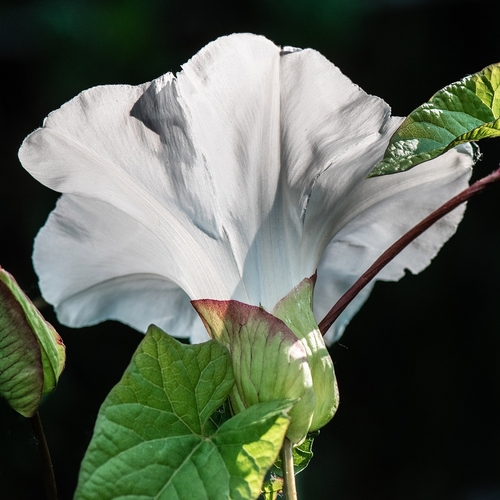
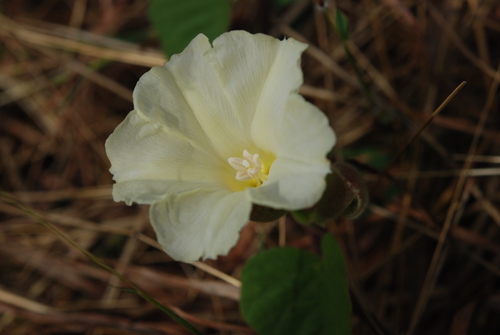
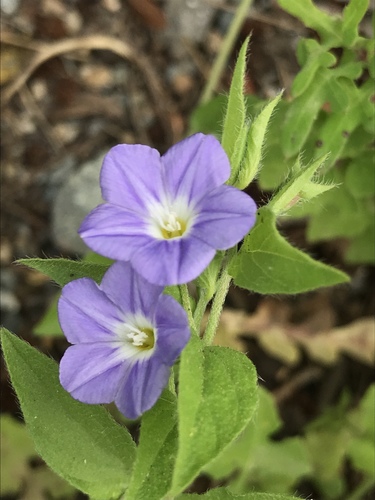
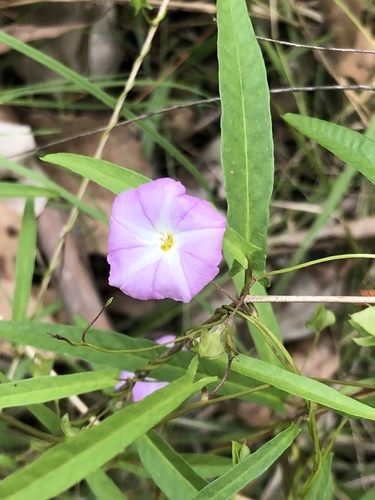
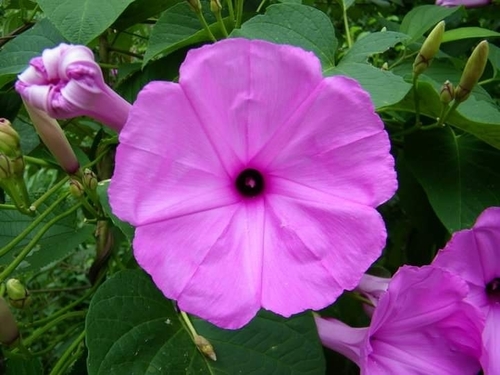
Ipomoea jalapa (also referenced as Ipomoea purga in this description) is a vine that can grow up to 12 feet (3.7 m) tall. Fresh roots of this species are black on the outside, white and milky on the inside, and vary in size based on their age. It produces heart-shaped leaves and purple, trumpet-like flowers. The plant material is difficult to break down, but pulverization becomes much easier and produces a finer powder if it is triturated with cream of tartar, sugar of milk, or other hard salts. Powdered Ipomoea purga prepared for ingestion is pale grayish brown in color. Ipomoea purga is native to Mexico, and has become naturalized in other parts of the neotropics. English explorers called this plant "mechoacán" and "mechoacan potato". Its root contains a resin known as jalap, which is a powerful cathartic that causes intense vomiting and diarrhea; these effects can prove fatal in rare cases. When applied to a wound, the plant is said to induce purgation. The resin from Ipomoea purga can be dissolved in ethanol as a tincture, or in diethyl ether. Resin components that are insoluble in ether are odorless, while alcohol-soluble resin components have an odor and are typically brownish in color. A compound with the chemical formula C28H52O14 produced in the roots of Ipomoea purga can be split into a sugar molecule (C6H12O6) and convolvulinolic acid (C16H30O3).