About Ipomoea heptaphylla Sweet
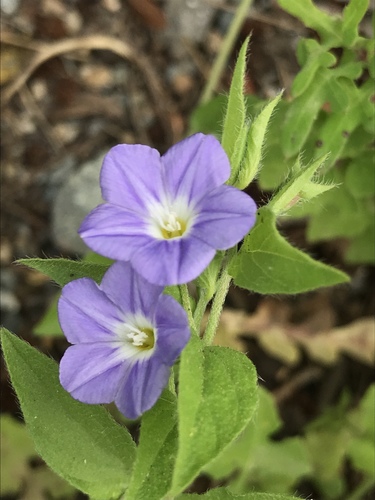
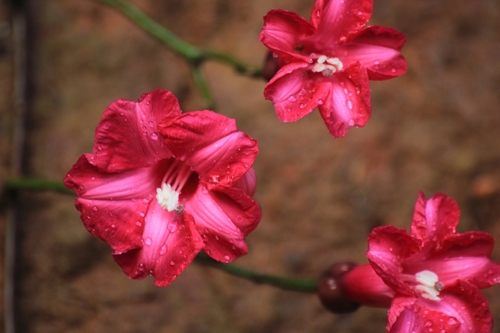
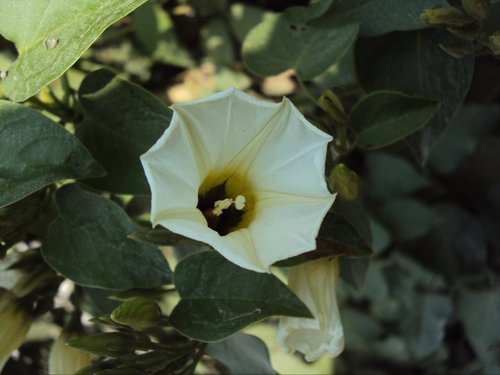
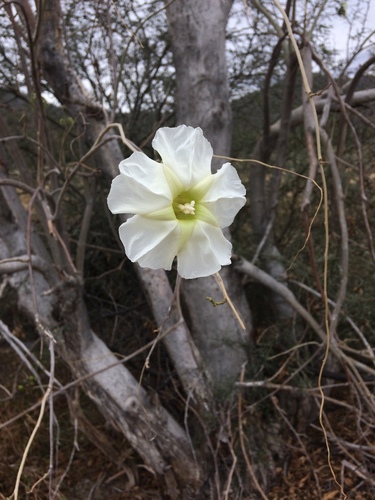
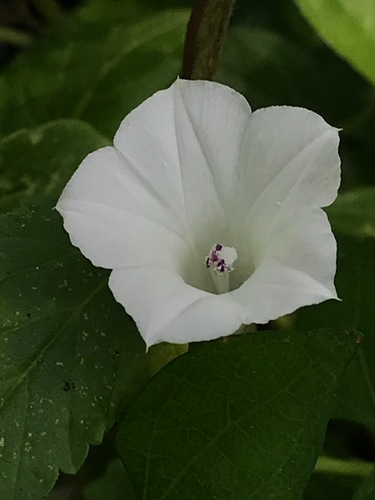
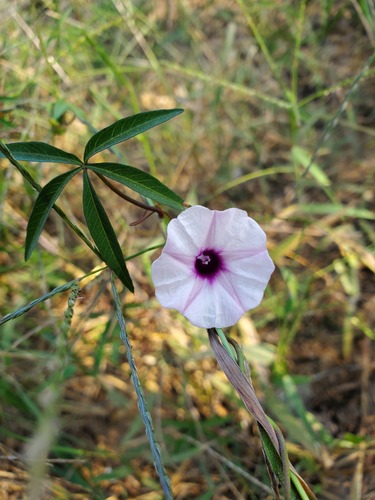
Ipomoea heptaphylla Sweet is an annual or short-lived perennial vine. It climbs via thin stems that wind around the stems of other plants, and additionally, its leaf petioles and flower peduncles can also twist around supporting objects. The stems bear small rough points, and there are hairs inside the corolla; otherwise, the plant is entirely glabrous. Its flowers are pink or purple. Leaf shape is somewhat variable: most individuals have compound leaves palmately divided into five leaflets, but lanceolate-leaved individuals occur in neighboring populations. The specific epithet heptaphylla means 'seven-leaved'. When leaves are palmate, all leaflets are approximately the same size, and the entire leaf has roughly round dimensions. This species is quite similar to Ipomoea cairica, which grows across most of its range; both share similar leaves, flowers, and twining petioles, but Ipomoea heptaphylla is less robust, has smaller flowers, and much longer peduncles. Further, I. cairica has flower petals that are rounded at their ends, while I. heptaphylla's petals are slightly pointed, and I. cairica leaves are longer than they are broad. Initial references to this species come from Brazil, India, and Cuba, with other early collections from Jamaica, Paraguay, Tanzania, Sri Lanka, northernmost Mexico, Texas, and Arkansas. The first specimens of the species from India, likely the first collected anywhere in the world, were gathered near what is now Chennai (formerly Madras), in the area of present-day Mambalam-Saidapet (then called Marmelon), from the Opuntia gardens (known as Nopalry) belonging to Scottish physician and avid gardener James Anderson. Anderson was attempting to develop a cochineal farming industry at this site, with little success. Herbarium specimens from these gardens were sent to Germany, and were used as the type material to formally establish this taxon in 1803. Another early collection from the region was made in Sri Lanka; seeds from this collection were sent to a female gardener in England in the 1840s, and the grown plants were featured in Curtis's Botanical Magazine under the name Ipomoea pulchella, given the common name 'handsome bindweed' for the publication. In 2014, the species was recollected in Aurangabad district, Maharashtra, India, after 53 years without any identified collections in the country. In Africa, the species has been recorded growing in Angola, Mozambique, Namibia, South Africa (former Transvaal Province), pre-secession Sudan, continental Tanzania, Luangwa (Zambia), and Zimbabwe. The earliest African specimens were collected in Tanganyika in the 1930s, and the species is very uncommon in South Africa. Although Ipomoea heptaphylla has long been considered native to the United States (as I. wrightii was first described from Texas), it has recently been added as an invasive species in the US in some online databases. In India, the species is known to grow on roadsides located in cultivated areas. Seeds of Ipomoea heptaphylla have occasionally been offered for sale in commercial horticultural catalogues. It was first cultivated in Britain in 1827.