About Ipomoea hederacea Jacq.
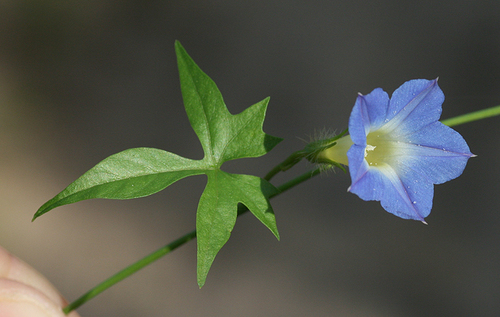
Ipomoea hederacea, commonly known as ivy-leaved morning glory or Kaladana, is a flowering plant that belongs to the bindweed family. This species is native to tropical regions of the Americas, and was later introduced to North America, where it currently grows from Arizona to Florida, and northward to Ontario and North Dakota. Like most other species in the bindweed family, it is a climbing vine with alternate leaves growing on twining stems. Its flowers range in color from blue to rose-purple, have a white inner throat, and bloom from summer through late fall. Its leaves are typically three-lobed, but may occasionally be five-lobed or unlobed (entire). Flowers grow in clusters of one to three, and measure 2.5–4.5 cm in both length and width. Its sepals taper to long, curved backward tips, and are 12–24 mm long. Ipomoea hederacea shares several traits with its close relative Ipomoea purpurea, and looks almost identical to wild forms of Ipomoea nil. In ecological interactions, white-tailed deer make very little use of ivy-leaved morning glory. Northern bobwhite and seed-eating songbirds only infrequently consume its large seeds. Some larger butterflies, including swallowtails and fritillaries, along with the ruby-throated hummingbird, visit its flowers. Most pollination of Ipomoea hederacea occurs through self-pollination; one study population recorded a selfing rate of 93%. Ipomoea hederacea has been studied as a model of character displacement. When it grows together with Ipomoea purpurea, natural selection favors I. hederacea individuals with anthers that cluster more tightly around the stigma. This trait is thought to reduce pollination of I. hederacea by I. purpurea, which produces sterile seeds if it occurs. Such unsuccessful pollination wastes the parent plant's resources and lowers its fitness. This fitness reduction is not reciprocal: I. hederacea pollen does not germinate on I. purpurea stigmas, which gives I. purpurea a competitive advantage. This selective pressure leads I. hederacea to develop an anther barrier over its stigma that blocks pollen from other species, and this may also increase self-pollination. When I. hederacea grows without I. purpurea, this selective pressure is not present, and its anther barriers are looser and less consistent.