About Ipomoea coccinea L.
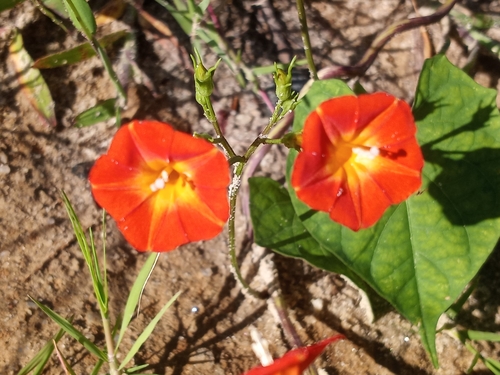
Ipomoea coccinea L., commonly called red morning glory, is a fast-growing, twisting climbing flowering vine that attracts butterflies. Its leaves are heart-shaped at the base, most commonly three-lobed, typically 50–100 mm (2–4 inches) long, and roughly half as wide. The vines can reach 3 meters (10 feet) or more in length. Its flowers are dull red with an orange throat, and grow in clusters of up to six. The species name coccinea, Latin for 'scarlet', refers to the flower color. Ipomoea coccinea is often confused with Ipomoea quamoclit due to their similar flowers, but the two species have very different leaves. Ipomoea quamoclit has more deeply divided leaves that resemble pine boughs, giving it the common name cypress vine. Ipomoea coccinea can also be distinguished from Ipomoea hederifolia by flower color: Ipomoea coccinea has red-orange flowers, while Ipomoea hederifolia has darker red flowers, and Ipomoea hederifolia also has more pinched-shaped seeds. The leaves of Ipomoea coccinea are lobed but not divided into separate leaflets, with one leaf growing per node along the stem. Leaf blade edges vary, with some having teeth and lobes. This species is native to tropical America, and has been introduced to much of the United States. It typically grows in disturbed areas including roadsides, stream banks, fence rows, old fields, and other waste areas. In central India, Ipomoea coccinea flowers between November and January, and fruits in January and February. It is cultivated across many parts of India both as an ornamental plant and for its medicinal properties; its roots are used to induce sneezing.