About Ipomoea batatas (L.) Lam.
Ipomoea batatas (L.) Lam., commonly known as sweet potato, is a herbaceous perennial vine. It produces alternate leaves that are either triangular or palmately lobed, and medium-sized sympetalous flowers. Its stems typically crawl along the ground, and form adventitious roots at the nodes. Leaves are arranged spirally along stems, with leaf stalks measuring 13 to 51 centimetres (5 to 20 inches) long. Leaf blades are highly variable in shape, ranging from 5 to 13 cm (2 to 5 in) long; shapes include heart-shaped, kidney-shaped, egg-shaped, rounded, triangular, and spear-shaped, and edges can be entire, toothed, or often three to seven times lobed, cut, or divided. Most leaf surfaces are hairless, with rare hairiness, and leaf tips range from rounded to pointed. Leaves are mostly green, but may turn purple from anthocyanin accumulation, especially along leaf veins. Total stem length varies by cultivar, ranging from 0.5 to 4 metres (1+1⁄2 and 13 feet), with some cultivars producing shoots up to 16 m (52 ft) long that do not form underground storage organs.
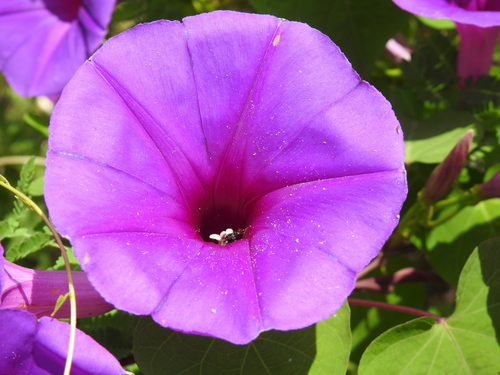
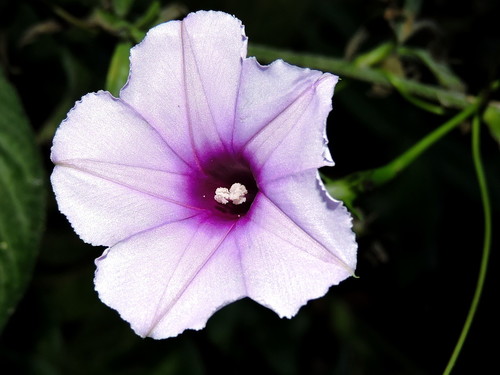
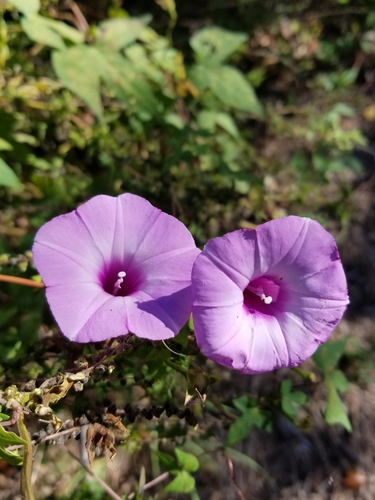
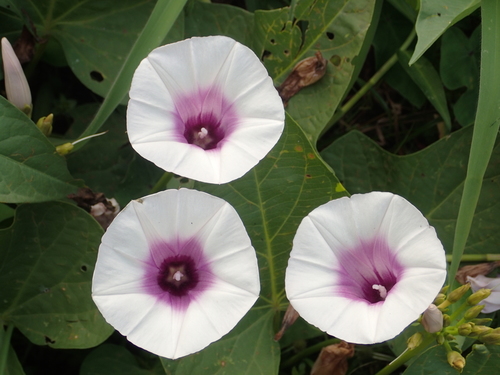
The flowers are hermaphrodite, five-part, and short-stalked, borne singly or in small groups in erect, cymose inflorescences that emerge from leaf axils. Flowering occurs under short day conditions. Small sepals are elongated, tapering to a spiky point, and measure 10 to 15 millimetres (3⁄8 to 5⁄8 in) long (rarely only 7 mm), usually with fine hair or cilia; the three inner sepals are slightly longer. The corolla is 4 to 7 cm (1+1⁄2 to 2+3⁄4 in) long, funnel-shaped, folded, with a shorter tube, and ranges in color from lavender to purple-lavender; the throat is usually darker, though white corollas can also occur. Enclosed stamens are of unequal length, with glandular filaments. The two-chambered ovary is superior, with a relatively short style. Seeds are only produced via cross-pollination. Flowers open before sunrise, remain open for a few hours, then close in the morning and begin to wither.
The edible tuberous root is long and tapered, with smooth skin that can be yellow, orange, red, brown, purple, or beige. Root flesh ranges in color from beige to white, red, pink, violet, yellow, orange, and purple. Sweet potato cultivars with white or pale yellow flesh are less sweet and moist than those with red, pink, or orange flesh.
This species does not tolerate frost, and grows best at an average temperature of 24 °C (75 °F), with abundant sunshine and warm nights. Annual rainfall of 750–1,000 mm (30–39 in) is considered most suitable, with a minimum of 500 mm (20 in) during the growing season. The crop is sensitive to drought at the tuber initiation stage 50–60 days after planting, and is not tolerant to waterlogging, which can cause tuber rot and reduce storage root growth when aeration is poor. Tuberous root maturity takes two to nine months, depending on cultivar and growing conditions. With proper care, early-maturing cultivars can be grown as an annual summer crop in warm temperate areas, such as the Eastern United States and China. Sweet potatoes rarely flower when daylight is longer than 11 hours, which is normal for regions outside the tropics. They are mostly propagated by stem or root cuttings, or by adventitious shoots called "slips" that grow from tuberous roots during storage; true seeds are only used for breeding purposes.
Sweet potatoes grow well in many farming conditions and have few natural enemies, so pesticides are rarely needed. They can be grown in a variety of soils, but well-drained, light- to medium-textured soils with a pH range of 4.5–7.0 are most favorable. They can be grown in poor soils with little fertilizer, but are very sensitive to aluminium toxicity, and will die around six weeks after planting if lime is not added at planting in aluminium-rich soils. Because they are planted from vine cuttings rather than seeds, sweet potatoes are relatively easy to plant. Their rapidly growing vines shade out weeds, so little weeding is needed. DCPA, also known as Dacthal, is a commonly used herbicide to remove unwanted plants that may interfere with growth. In the tropics, the crop can be maintained in the ground and harvested as needed for market or home consumption. In temperate regions, sweet potatoes are most often grown on larger farms and harvested before the first frosts.
Sweet potatoes are cultivated throughout tropical and warm temperate regions wherever there is sufficient water to support growth. They became a common food crop in Pacific Islands, South India, Uganda, and other African countries. A cultivar called boniato is grown in the Caribbean; it has cream-colored flesh, unlike the common orange hue of other cultivars, and is less sweet and moist than other sweet potatoes, with a different consistency and delicate flavor. Sweet potatoes have been part of the diet in the United States for most of its history, especially in the Southeast. Annual per capita consumption of sweet potatoes in the United States is only about 1.5–2 kg (3+1⁄2–4+1⁄2 lb), down from 13 kg (29 lb) in 1920. Orange sweet potatoes, the most common type found in the US, receive higher consumer appearance liking scores than yellow or purple cultivars. Purple and yellow sweet potatoes are less well liked by consumers than orange sweet potatoes, possibly because consumers are familiar with orange as the typical color associated with sweet potatoes.
In the Southeastern United States, harvested sweet potatoes are traditionally cured to improve storage, flavor, and nutrition, and to allow wounds on the periderm of the harvested root to heal. Proper curing involves drying freshly dug roots on the ground for two to three hours, then storing them at 29–32 °C (85–90 °F) with 90 to 95% relative humidity for five to fourteen days. Cured sweet potatoes can be stored for thirteen months at 13–15 °C (55–59 °F) with over 90% relative humidity; colder temperatures injure the roots.
When compared to other staple foods on a dry weight basis to account for differing water contents, sweet potato provides less edible energy and protein per unit weight than cereals, but has higher nutrient density than cereals. According to a study by the United Nations Food and Agriculture Organization, sweet potatoes are the most efficient staple food to grow in terms of farmland output, yielding approximately 290,000 kilojoules per hectare (28,000 kcal/acre) daily.