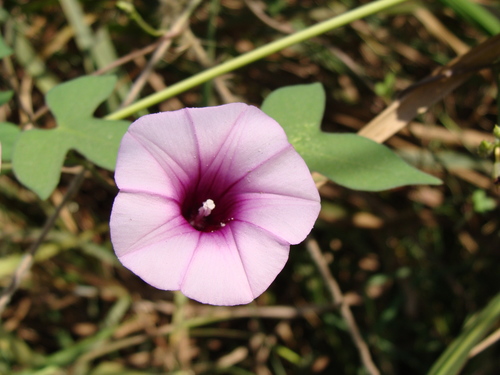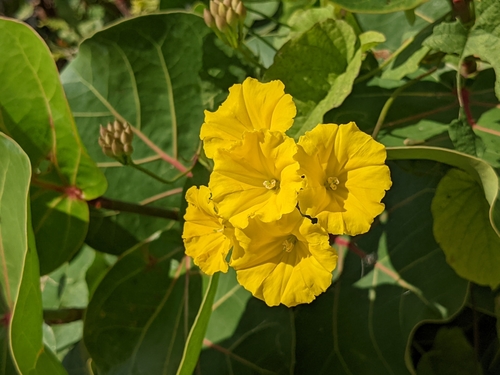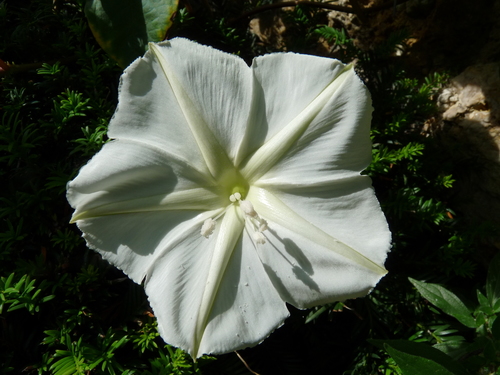
About Ipomoea alba L.
Ipomoea alba is a perennial herbaceous liana with twining stems that grows 5–30 m (20–100 ft) tall. Its leaves are either entire or three-lobed, 5–15 cm (2–6 in) long, and grow from a leaf stalk 5–20 cm (2–8 in) long. The flowers are large, fragrant, and white or pink, with a diameter of 8–14 cm (3–6 in). Flowers open quickly in the evening, stay open throughout the night, and remain open until they contact morning dew. On overcast days, blossoms may stay open longer. Flowers also tend to remain open longer during cool temperatures, though cool conditions can make the flower segments snag or tear as they open.
The seeds range in color from yellowish light brown to nearly black. They are nearly round, 10–12 mm (0.4–0.5 in) long and 8–9 mm (0.3–0.4 in) wide. Seeds are quite buoyant; in an experiment, they floated in water for a year and a half. The leaves, flowers, and seeds of Ipomoea alba are toxic to humans, cats, dogs, and livestock.
Historically, Mesoamerican civilizations used this morning glory to process latex from the Castilla elastica tree to make bouncing rubber balls. The sulfur contained in Ipomoea alba cross-linked the rubber, a process that predated Charles Goodyear's discovery of vulcanization by at least 3,000 years.
Today, Ipomoea alba is widely cultivated as an ornamental plant grown for its flowers. In areas too cold for the plant to survive winter, it can be grown as an annual. Originating from the tropics, it flowers best under the short summer daylight photoperiod it evolved for. While it can be grown successfully to produce flowers in northern regions, excessively long summer days reduce its flowering. For this reason, at higher latitudes it often does not set buds and bloom until early autumn, when daylight length returns to near 12 hours. Propagation is usually done by seed. The seed, which resembles a small brownish nut, should be nicked with a file and then soaked overnight before planting. In some regions, Ipomoea alba is an invasive species that can cause problems in agricultural settings.