About Iphiclides podalirius (Linnaeus, 1758)
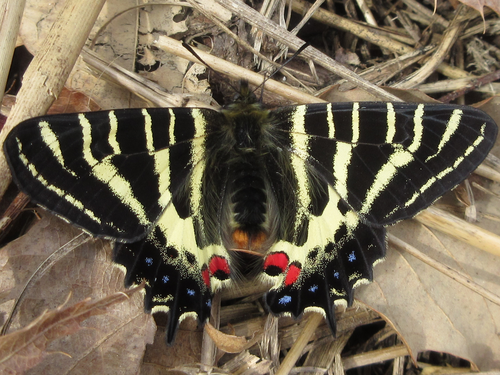
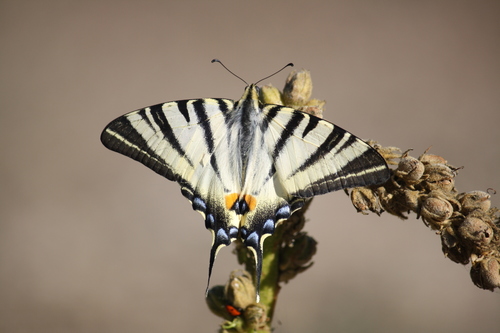
Iphiclides podalirius, commonly known as the scarce swallowtail, is a very large, distinctive butterfly. Males of this species have a wingspan of 60–80 millimetres (2.4–3.1 in), while females have a wingspan of 62–90 millimetres (2.4–3.5 in). The background color of its wings is creamy white or pale yellow. The front wings feature six tiger stripes and wedge-shaped markings. At the outer edge of the hind wings there are blue crescent markings, an oblong orange spot at the back corner, and a relatively long tail. This species looks quite similar to Papilio machaon, Papilio hospiton, Papilio alexanor, and Protographium marcellus.
Despite its English common name "scarce swallowtail", this species is actually quite common. The name comes from the fact that it only rarely occurs as a migrant to the United Kingdom. It is widespread across most of Europe (excluding northern regions) and the East Palearctic realm. Its range extends north to Lower Lusatia and central Poland, and east across Asia Minor and Transcaucasia as far as the Arabian Peninsula, Pakistan, India, and western China. A small number of specimens have been reported from central Sweden and the United Kingdom, but these individuals are most likely strays rather than regular migrants.
These butterflies live in gardens, towns, countryside fields, and open woodlands. They occur in areas with sloe thickets, and are especially common in orchards. In the Alps, they can be found at altitudes up to 2000 m, though they generally prefer foothills and lower elevations. In the Morava River floodplain of the Slovak Republic, the presence of Iphiclides podalirius is a good indicator of relatively well preserved xerothermic grassland habitats with forest-steppe vegetation that have no history of cutting.