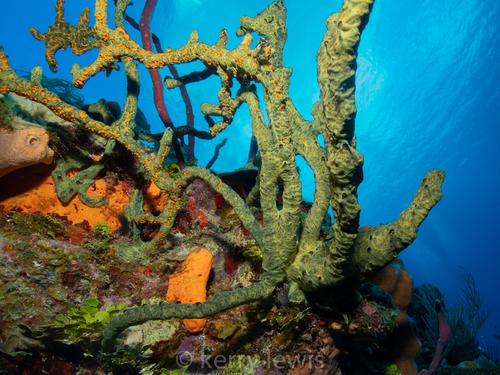
About Iotrochota birotulata (Higgin, 1877)
Commonly known as the green finger sponge, Iotrochota birotulata most often grows upright or sprawling cylindrical branches that occasionally divide. Its branches are roughly 4 centimetres (1.6 in) in diameter and can reach 50 centimetres (20 in) in length. Young individuals and some large specimens have an encrusting growth habit: they grow across rock surfaces in a layer a few millimetres thick, with occasional short chimney-shaped outgrowths. Other individuals form a series of vertical tubes, each ending in a large opening called an osculum. These variations in growth habit once led researchers to think these forms were multiple separate sponge species. However, specimens growing in reef caves often have an encrusting base with a central, finger-like cluster of branches, so it is now accepted that all these different forms belong to a single species. It is thought the differing forms may be caused by different environmental conditions. In branched individuals, osculi are located on the upper side of branches and may sit slightly raised above the surrounding tissue. The sponge has a soft but resilient texture; when squeezed, it releases a purple fluid. Its overall base colour is purplish black, but its epidermis is often covered by a layer of bright green cells. These green cells form dendritic patterns on the sponge's surface, and cover the subsurface canals that lead to the osculi. The green finger sponge occurs in the Caribbean Sea, at depths between 2 and 15 metres (6 ft 7 in to 49 ft 3 in). Its known range includes the West Indies, the Bahamas, southern Florida, Venezuela and northern Brazil, but it is not found in Bermuda. It lives on reefs, in deeper water outside reef crests, and on both the underside and surfaces of rocks in shallow bays.

