About Iochroma arborescens (L.) J.M.H.Shaw
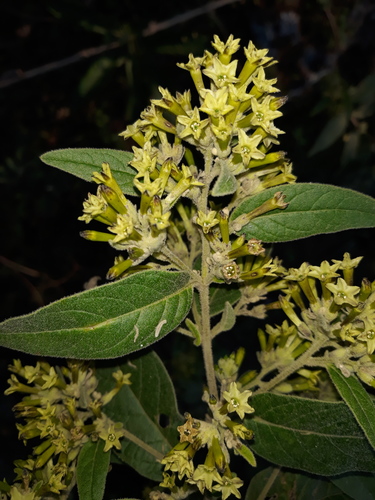
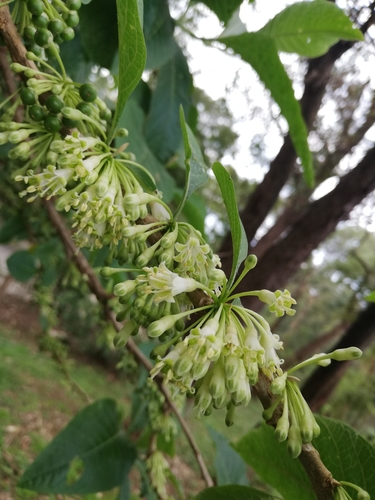
Iochroma arborescens (L.) J.M.H.Shaw grows as a large shrub or small tree, reaching up to 10 meters in height. Its flowers grow in clusters on bare sections of branches located below the leaves. The plant's leaves are alternate, simple, and elliptical in shape, with a narrow long V-shape at the base and a variably narrowed point at the tip. They measure 15 to 30 cm long and 5 to 15 cm wide, with entire or slightly wavy margins, and are hairless except when young. Young stems and young leaves are covered in rusty hairs. Its fragrant flowers grow in clusters of 30 or more, with broadly funnel-shaped tubes around 1.2 cm long and recurving lobes. The protruding stamens are greenish-white to cream in color. The bright orange fruit is round, and around 1 cm across. There is evidence that these fruits are dispersed by birds. This plant flowers sporadically throughout the year, and generally fruits from March to July.
Iochroma arborescens is native to Central America, South America, and the Caribbean, and is a characteristic species of montane cloud forest clearings and forest edges, growing at elevations between 300 and 2000 meters. In Puerto Rico and the United States Virgin Islands, the US Department of Agriculture classifies it as a native plant species.
The flowers of Iochroma arborescens secrete a rare fragrant compound called orcinol dimethyl ether (also known as 3,5-Dimethoxytoluene), which is also found in roses and the flowers of the Amaryllid Narcissus tazetta. This volatile compound is almost undetectable by the human nose, but experiments show that honey bees can readily detect it via their sense of smell.
While Iochroma arborescens is rarely described in literature as a particularly poisonous plant, two sets of herbarium notes from dried specimens held by the New York Botanical Garden contradict this. A specimen collected in Peru bears the note 'sap very poisonous' and lists the common name 'Catahui', while another collected in Martinique under the synonym Atropa arborescens has a German note that reads 'Die Pflanze enthält narkotisch giftige Stoffe', which translates to 'the plant contains narcotic poisons'.
In folk medicine, leaf extracts of this plant have been used to treat cancerous growths. Scientific studies have found that compounds in the plant show in vitro cytotoxic activity against a range of human cancer cell lines. A hot infusion made from the leaves or bark has also been used to treat bruises and sprains.
Iochroma arborescens is grown as an ornamental tree for gardens and natural landscaping projects, valued for its attractive flowers and abundant beautiful golden fruit. The fruit is eaten by many bird species, which is the origin of its Brazilian common name Fruta-de-sabiá, meaning 'thrush fruit' in Portuguese.