About Intellagama lesueurii (Gray, 1831)
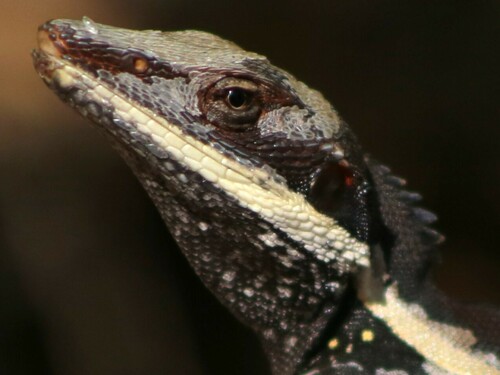
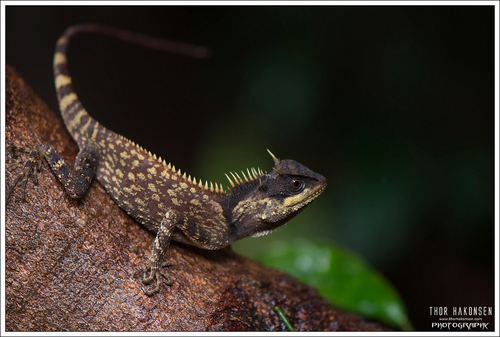
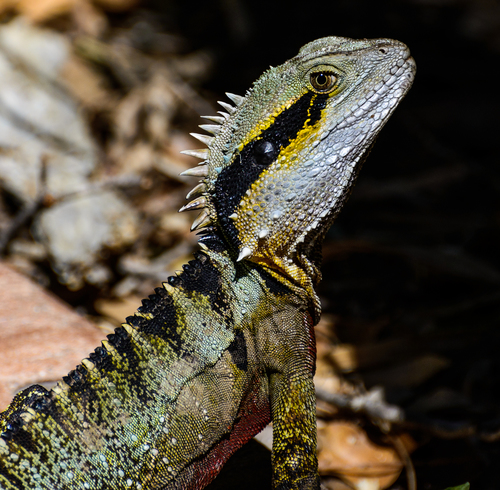
Australian water dragons, Intellagama lesueurii, have long, powerful limbs and claws built for climbing, along with a long, muscular, laterally-compressed tail that aids swimming. They also have prominent nuchal and vertebral crests; a nuchal crest forms a central row of spikes at the base of the head, and these spikes continue down the spine, decreasing in size as they approach the base of the tail.
Around two-thirds of an Australian water dragon's total length comes from its tail. Adult females reach approximately 60 cm (2 feet) in total length, while adult males can grow slightly longer than one metre (39 inches) and weigh around 1 kg. Males have more striking colouration and larger heads than females, and juvenile individuals have much less distinct colour patterns.
As the common name indicates, the Australian water dragon is a semi-aquatic species that lives closely associated with water. It occurs near creeks, rivers, lakes, and other water bodies that provide basking sites such as overhanging branches or rocks exposed to open or filtered sun. The species is very common in the rainforest section of Brisbane Botanic Gardens, Mount Coot-tha in Queensland, where a monument has been built to honor it, and it also hosts a large population in Brisbane's Roma Street Parklands. Anecdotal reports note a small introduced colony in the Sixth Creek area of Forest Range, South Australia, hundreds of kilometers outside the species' natural range. This colony was likely brought to the area by a local reptile enthusiast in the 1980s.