About Inonotus obliquus (Fr.) Pilát
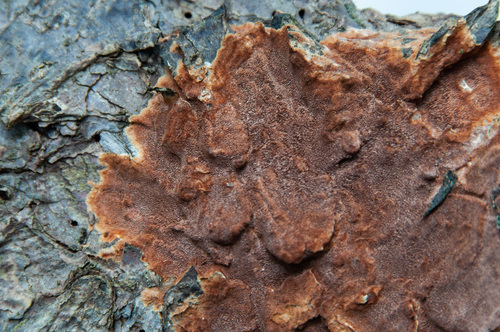
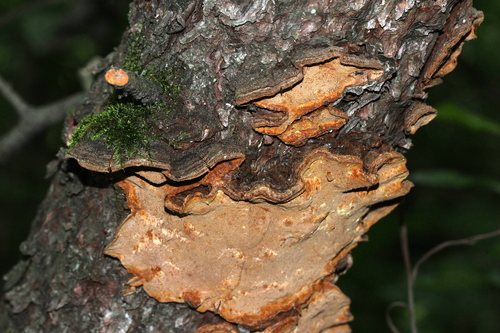
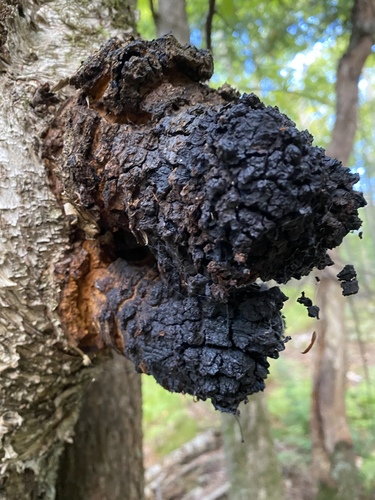
Inonotus obliquus (commonly called chaga) causes white heart rot in its host trees. Chaga spores enter host trees through wounds, especially poorly healed branch stubs. The white rot decay spreads throughout the host tree’s heartwood. During the infection cycle, sapwood penetration only occurs around the sterile exterior mycelium mass. The chaga fungus continues to cause decay inside living host trees for 10 to over 80 years. While the host tree remains alive, the fungus only produces sterile mycelial masses, which form the black exterior conk. The sexual reproductive stage begins only after the tree, or a portion of the tree, is killed by the infection. At this stage, I. obliquus starts producing fertile fruiting bodies under the tree’s bark. These fruiting bodies begin as a whitish mass that turns brown as they mature. Because the sexual stage develops almost entirely under bark, the fruiting bodies are very rarely seen. These fruiting bodies produce basidiospores that spread the infection to other vulnerable trees. The mycelial canker of chaga is typically 10–25 centimetres (4–10 in) wide, while the underlying crust ranges from 5–50 cm (2–19+1⁄2 in) long. Inonotus obliquus is most commonly found in the Circumboreal Region of the Northern Hemisphere, distributed across birch forests there. It generally grows on birch (Betula spp.) trees, but has also been recorded growing on alder (Alnus spp.), beech (Fagus spp.) and poplar (Populus spp.). Attempts to cultivate this fungus on potato dextrose agar and other simulated growth media resulted in reduced metabolite production, with metabolites that differ markedly from those produced by wild chaga. Cultivated chaga produces fewer phytosterols; this reduction is particularly notable for lanosterol, an intermediate in the synthesis of ergosterol and lanostane-type triterpenes. Inonotus obliquus is commonly marketed as a dietary supplement claimed to offer various health benefits, but there is no sufficient scientific evidence to confirm its safety or effectiveness. Product quality also varies due to inconsistent processing and labeling. Traditionally, chaga is grated into a fine powder to brew a beverage that resembles coffee or tea, with a strong flavor similar to Chinese herbal tea. Caution is recommended for chronic use, because chaga contains extremely high concentrations of oxalates. Hot water extraction is the most common preparation method. To make a decoction, blocklike pieces of chaga are simmered in multiple quarts of water until the water volume reduces, leaving a concentrated liquid that contains some of chaga’s water-soluble compounds. Preparations produced this way in China and Japan are exported globally. A pure chaga extract can contain approximately 35% β-D-glucans. When making chaga tea at home, chaga chunks can be reused multiple times. The Potawatomi people call this fungus shkitagen, and use it as firekeeping tinder. According to Potawatomi biologist Robin Wall Kimmerer, "Once an ember meets shkitagen it will not go out but smolders slowly in the fungal matrix, holding its heat. Even the smallest spark, so fleeting and easily lost, will be held and nurtured if it lands on a cube of shkitagen."