About Inocarpus fagifer (Parkinson ex F.A.Zorn) Fosberg
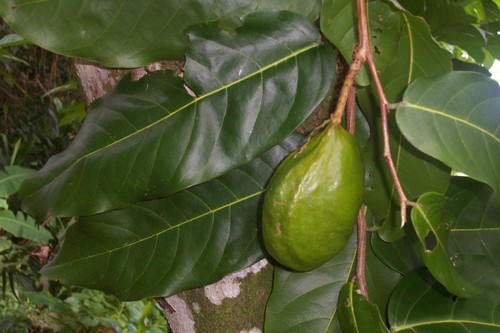
Inocarpus fagifer, commonly known as Tahitian chestnut or ivi, exhibits wide diversity in the size, form, shape and colour of the whole tree, as well as its leaves, flowers and fruit. Due to its long history of cultivation and tendency to become naturalised when introduced, the species likely holds multiple originally farmer-selected cultivars that have not yet been recognised or described across its broad range. Tahitian chestnut is a medium-sized evergreen tropical tree. It can reach 30 metres in height, though 20 metres is more typical, with a crown diameter of 4–6 m. Mature trunks have a standard diameter at breast height of 300 mm, though some individuals grow as large as 900 mm across. Trunks are distinctly buttressed at the base and fluted. Branches are arranged spirally, with secondary branching forming a dense network within the tree canopy. The bark is rough, flaky, and brown, and becomes greyer as the tree ages. A dense network of lateral roots spreads from the buttresses through the topsoil surrounding the tree, and the tree only develops a shallow taproot. It has a typical lifespan of 80–90 years. Its dark green leaves are simple, oblong, alternate, and leathery. They measure 160–390 mm long and 70–130 mm wide, with a 5 mm long petiole. Leaves have a pointed apex, lobed base, an entire margin, and opposite yellow veins. Fragrant flowers cluster along a short rachis at the ends of branches and twigs. Each flower is roughly 10 mm long, with five white to cream or pale yellow petals. Trees begin flowering when they are 3 to 5 years old. Flowering typically occurs in November and December, with fruiting following in January and February, though this timing varies across the species' range and between years. Trees first produce fruit at approximately eight years old. The fruits are slightly flattened, with an irregularly ovoid, rounded or oblong shape, and feature a flange at one end. Fruits grow singly or in clusters, weigh 50–110 g, and measure 46–130 mm long, 34–120 mm wide, and 40 mm thick. Smooth skin covers a fibrous shell that holds the seed kernel. As fruits ripen, their colour changes from green to yellow or orange brown. Mature fruits are usually indehiscent. The seed is white and kidney-shaped, held within a thin brown fibrous shell. It is relatively large, weighing 5–50 g, and measuring 20–70 mm long by 16–40 mm wide. The seed is toxic when raw, but edible after cooking, and it is perishable with a short shelf life. The fruit's fleshy mesocarp, or pulp, is eaten by cockatoos and flying foxes, which act as the species' seed dispersal agents. Tahitian chestnut grows in humid lowland tropical climates, with an annual moderate to high rainfall that ranges from 1,500–4,300 mm, either uniformly distributed through the year or falling mainly in summer. It grows at altitudes between 0 and 500 m above sea level. It tolerates a very wide range of soils, including highly calcareous and saline soils, poorly drained to waterlogged soils, soils with medium to very low fertility, and mildly acidic to very alkaline coastal soils. The species was evidently cultivated more intensively in the past, and has since become extensively naturalised, so it is now found mainly in the wild. Its native and naturalised range extends from Malaysia in the west, across Melanesia, north-eastern Australia and Micronesia, to the Marquesas Islands of Polynesia in the east. It is commonly found in secondary forest, along the edges of old gardens, on riverbanks, in swamps, coastal areas, coconut plantations and mangroves. This tree has a wide variety of traditional uses, with almost every part of the plant exploited. Leaves and bark are used in herbal medicine. In Fiji, ivi leaves are one traditional material used for thatching traditional bure buildings. Fallen branches are used as firewood, and green wood is burned to dry copra. The timber is used for crafts such as carvings and tool handles, as well as for building canoes and general light construction. Young ivi leaves are used to cover food in the traditional lovo oven. The fleshy mesocarp is inedible for humans, but the seed kernels are an important indigenous food source for many Pacific island countries. The kernel has a protein content of about 5% and carbohydrate content of 22%, and requires cooking to become edible. Common preparation methods include roasting, grilling, boiling and baking. In Papua New Guinea, the Solomon Islands, Vanuatu, Fiji, and Polynesia, cooked kernels are often mashed into a pudding. The tree is used in agroforestry for coastal and soil stabilisation, as an overstorey for shade-loving crops such as cocoa, and as a windbreak. Its main commercial and subsistence products are edible kernels and timber. Trees older than 25 years can produce up to 75 kg of fruit per year.