About Iniistius pavo (Valenciennes, 1840)
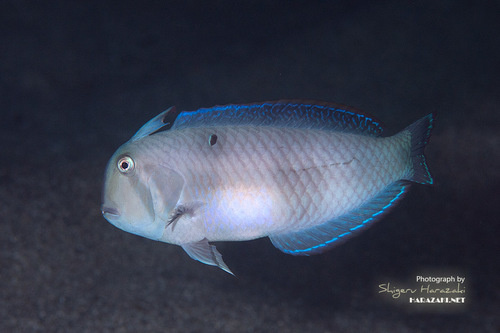
Iniistius pavo, the peacock wrasse, can be identified by a dark vertical bar located below the eye. This species also has a small dark spot below the forward section of its dorsal fin, a white patch on the side behind the pectoral fin, and an oblique brown bar underneath the eye. Adult individuals normally display 5 dark bars on their bodies, and the belly of adult females turns red. Juveniles have a black anal fin and two large eyespots with narrow white margins on their dorsal fin. The first two spines of the dorsal fin form a separate fin. Like all other members of the genus Iniistius, this species has a highly compressed body and a steep, sharp-edged forehead. In juveniles, this separate fin formed by the first two dorsal spines grows as a long, bannerlike filament, but this filament shortens as the fish ages. Juvenile coloration ranges from whitish with dark body bars to an overall solid brown color. Small juvenile individuals drift in the water, mimicking leaves and debris. This fish can reach a maximum total length of 42 centimetres, or 17 inches. Iniistius pavo was first formally described as Xyrichtys pavo in 1840, with its type locality given as Mauritius. When Theodore Nicholas Gill erected the genus Iniistius, he designated this species as the genus’s type species. This species has an Indo-Pacific distribution that stretches from the Red Sea and the east African coast south to KwaZulu-Natal, east to the Society Islands, north to southern Japan and Hawaii, and south to New Caledonia, Lord Howe Island, and New South Wales. It is also found in the Eastern Pacific, ranging from the Gulf of California to Panama and the Galapagos Islands. Iniistius pavo is typically a solitary, benthic and benthopelagic species. It inhabits lagoon and seaward reef areas where the substrate is made up of fine to loose, coarse sand. Juveniles are sometimes found in shallow estuaries. Adults are rarely found in water shallower than 20 metres, or 66 ft. The species dives into the sand to sleep safely at night, and will also bury itself to hide when threatened, using its sharp-edged snout to bury itself quickly. It feeds on hard-shelled invertebrates including molluscs and crustaceans. Juveniles use their elongated, detached front dorsal fin to mimic drifting dead leaves.