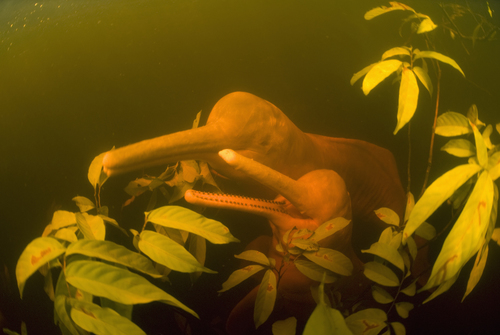
About Inia geoffrensis (Blainville, 1817)
Inia geoffrensis, commonly called the Amazon river dolphin, is the largest river dolphin. Adult males reach a maximum length of 2.55 m (8.4 ft, average 2.32 m / 7.6 ft) and a maximum weight of 185 kg (408 lb, average 154 kg / 340 lb), while females reach a maximum length of 2.15 m (7.1 ft, mean 2.0 m / 6.6 ft) and a maximum weight of 150 kg (330 lb, average 100 kg / 220 lb). This species shows very clear sexual dimorphism: males are 16% to 55% longer and heavier than females. This pattern is unique among river dolphins, where females are typically larger than males. The Amazon river dolphin has a robust, strong yet flexible body. Unlike oceanic dolphins, its cervical vertebrae are not fused, which lets the head turn 90 degrees. Its flukes are broad and triangular. The dorsal fin is keel-shaped, short in height but very long, extending from the middle of the body to the caudal region. The pectoral fins are large and paddle-shaped; their length allows the dolphin to make circular movements, giving it exceptional maneuverability to swim through flooded forests, though this trait reduces its swimming speed. Body color changes with age: newborn and young Amazon river dolphins are dark grey, the color shifts to light grey in adolescence, and turns pink in adults from repeated abrasion of the skin surface. Males are usually pinker than females, due to more frequent trauma from intra-species aggression. Adult color ranges from solid to mottled pink, and some adults have a darker dorsal surface. This color variation is thought to depend on water temperature, water transparency, and geographical location. One albino specimen has been recorded, which was held in Duisburg Zoo's dolphinarium; as of 2020, this specimen and a second albino individual have died. Compared to other toothed whales, the species' skull is slightly asymmetrical. It has a long, thin snout, with 25 to 28 pairs of long, slender teeth on each side of both jaws. Its dentition is heterodont: teeth differ in shape and length, with separate functions for grabbing and crushing prey. Anterior teeth are conical, while posterior teeth have ridges on the inside of the crown. Despite having small eyes, the Amazon river dolphin appears to have good eyesight both in and out of water. It has a melon on its head, and muscles can modify the melon's shape when the dolphin uses biosonar. The species breathes every 30 to 110 seconds. Amazon river dolphins are the most widespread river dolphins. They are found across six South American countries: Bolivia, Brazil, Colombia, Ecuador, Peru, and Venezuela, in a range covering approximately 7 million square kilometres (2.7 million square miles). Their range boundaries are formed by waterfalls such as those on Brazil's Xingu and Tapajós rivers, as well as very shallow water. A series of rapids and waterfalls on the Madeira River have isolated a southern Amazon basin population in Bolivia, which is recognized as the subspecies I. g. boliviensis. The species is also distributed across the Orinoco River basin, except for the Caroni River and upper Caura River in Venezuela. The only connection between the Orinoco and Amazon basins is the Casiquiare canal. Dolphin distribution across rivers and surrounding areas changes with the season: in the dry season they stay within river beds, while in the rainy season when rivers overflow, they disperse into flooded forests and plains. Population estimation studies are difficult to analyze because of inconsistent used methodologies. One study of the 1,200-kilometre (750 mi) Solimões River stretch between Manaus and Tabatinga recorded an average of 332 ± 55 individuals per survey. Density was estimated at 0.08–0.33 animals per square kilometre in main channels, and 0.49 to 0.93 animals per square kilometre in river branches. Another study of a 120-kilometre (750 mi) stretch at the tri-border of Colombia, Brazil and Peru counted 345 individuals, with a density of 4.8 per square kilometre in tributaries around islands; densities of 2.7 and 2.0 individuals per square kilometre were recorded along river banks. A third six-day study at the mouth of the Caqueta River in the Amazon found density was higher at river banks, at 3.7 per kilometre, and decreased toward the center of the river. RAINY season studies recorded a density of 18 animals per square kilometre on the flood plain, while river and lake banks had densities between 1.8 and 5.8 individuals per square kilometre. These observations indicate that the Amazon river dolphin occurs at higher densities than any other cetacean. The Amazon river dolphin inhabits most aquatic habitats across its range, including river basins, major river courses, canals, river tributaries, lakes, and areas below rapids and waterfalls. Annual cyclical changes in river water levels drive seasonal movement patterns. During the dry season, dolphins stay in main river channels; during the rainy season, they can move easily into smaller tributaries, flooded forests, and floodplains. Males and females have different habitat preferences: males return to main river channels while water levels are still high, while females and their offspring remain in flooded areas for as long as possible. This is likely because it reduces the risk of male aggression toward calves and predation from other species. In Peru's Pacaya-Samiria National Reserve, photo-identification is used to recognize individual dolphins based on pigmentation patterns, scars, and beak abnormalities. Between 1991 and 2000, 72 individuals were identified, and 25 of these were re-sighted. Re-sighting intervals ranged from one day to 7.5 years. The maximum recorded movement range was 220 kilometres (140 mi), with an average of 60.8 kilometres (37.8 mi). The longest single-day distance recorded was 120 kilometres (75 mi), with an average of 14.5 kilometres (9.0 mi). An earlier study in the central Amazon River found most dolphins moved only a few dozen kilometres between dry and wet seasons, but three out of 160 observed dolphins were recorded moving over 100 kilometres (62 mi) from their original location. 2011 research concluded that photo-identification done by skilled operators using high-quality digital equipment can be a useful tool for monitoring Amazon river dolphin population size, movements, and social patterns. Amazon river dolphins are most commonly seen alone or in pairs, but may also form pods that rarely hold more than eight individuals. Pods as large as 37 individuals have been observed in the Amazon, though the average pod size is three. In the Orinoco, the largest recorded groups are 30 individuals, with an average size just above five. When hunting, up to 35 pink dolphins may work together to catch prey. Social bonds most often occur between mother and calf, but have also been observed in mixed groups or bachelor groups. The largest congregations form in areas with abundant food, particularly at river mouths. There is clear habitat segregation in the rainy season: males occupy river channels, while females and their calves stay in flooded areas. No such segregation occurs in the dry season. Larger group sizes are found in whitewater-influenced areas such as main rivers and lakes, especially during the low water season, than in blackwater-influenced smaller sections such as small channels and tributaries, due to higher prey fish abundance in whitewater areas. As apex predators in their freshwater habitat, Amazon river dolphin group size depends more on food availability and habitat than it does for oceanic dolphins, which group for protection from larger predators. Captive studies show Amazon river dolphins are less shy than bottlenose dolphins, but also less sociable. They are very curious and show a notable lack of fear of unfamiliar objects. Captive behavior does not necessarily match wild behavior: in the wild, Amazon river dolphins have been reported to hold fishermen's oars, rub against boats, pull underwater plants, and play with sticks, logs, clay, turtles, snakes, and fish. They are slow swimmers, usually traveling at 1.5 to 3.2 kilometres per hour (0.93 to 1.99 mph), but have been recorded swimming at up to 14 to 22 kilometres per hour (8.7 to 13.7 mph). When they surface, the tips of the snout, melon, and dorsal fin appear at the same time, and the tail rarely shows before the dolphin dives. They can shake their fins, and lift their tail fin and head above water to observe the surroundings. They occasionally jump out of the water, sometimes as high as 1 metre (3.14 ft). They are harder to train than most other dolphin species. Breeding is seasonal, and births take place between May and June. Birthing coincides with the flood season, which may be advantageous because females and their offspring stay in flooded areas longer than males. As water levels drop, reduced space increases the density of food sources in flooded areas, providing enough energy for infants to meet their high growth energy demands. Gestation is estimated to be around eleven months, and captive births take 4 to 5 hours. At birth, calves are 80 centimetres (31 in) long, and captive calves grow an average of 0.21 metres (0.69 ft) per year. Lactation lasts approximately one year. The birth interval is estimated to be between 15 and 36 months, and young dolphins are thought to become independent within two to three years. The relatively long duration of breastfeeding and parenting indicates a high level of parental care. Most pairs observed in the wild consist of a female and her calf, which suggests that long parental care periods support learning and development of young dolphins.

