About Indrella ampulla (W.H.Benson, 1850)
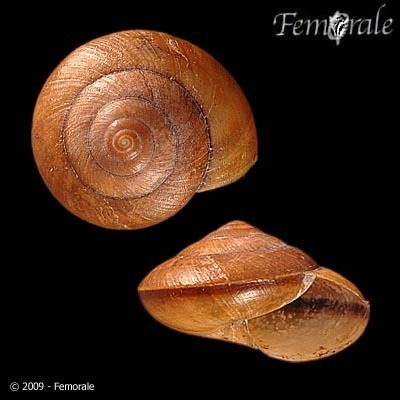
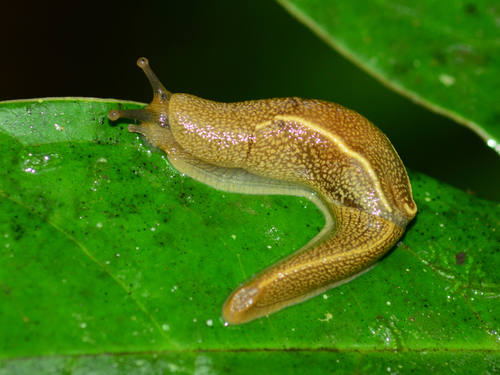
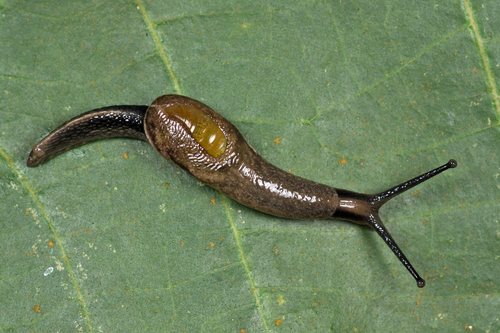
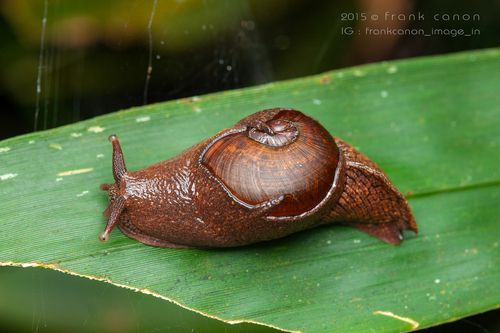
Indrella ampulla, first described by W.H. Benson in 1850, has a shell that resembles the shell of Vitrina. The shell is imperforate, has few whorls, and a very large aperture. It is made up mostly of protein, with only small amounts of calcium carbonate. The shell is obliquely ovate, globose in shape, and very thin. Half of the shell's total thickness is made up of epidermis. The entire surface of the epidermis is marked by folded growth lines, which are crossed by faint impressed spiral lines. The last whorl also has shallow irregular furrows across its surface. Shell color can range from brownish olive to dark brown to black. The spire is small, convex, and obtuse. This species has 3 and a half rapidly increasing whorls; the final whorl is much larger than the others, and is rounded at both the periphery and the underside. The aperture is very large, oblique, and roundly oval. It is the same color on the inside as it is on the outside, but the interior surface is smooth and glossy. The peristome is thin and membranaceous, and the columellar margin is strongly curved inward. The shell measures 38 to 63 mm in width, and 30 mm in height. The aperture itself measures 32 mm wide and 30 mm high. This species is found in the Western Ghats of India, specifically on the wetter western slopes of the Wynaad, Nilgiri, and Anaimalai Hills, at a moderate elevation of 3000 ft. It inhabits wet woodland, specifically tropical rainforest. Indrella ampulla is largely a terrestrial species, most often spotted on the forest floor, and it will occasionally cross forest roads. Despite being a terrestrial snail, it is also known to be partly arboreal. Individuals of this species have been recorded staying submerged underwater for around 30 minutes, with their upper tentacles occasionally breaking the surface of the water. Colonel Richard Henry Beddome of the British Indian forest service observed this species feeding on large fungi. Their diet is made up primarily of fungi and decaying organic matter.