About Indotyphlops braminus (Daudin, 1803)
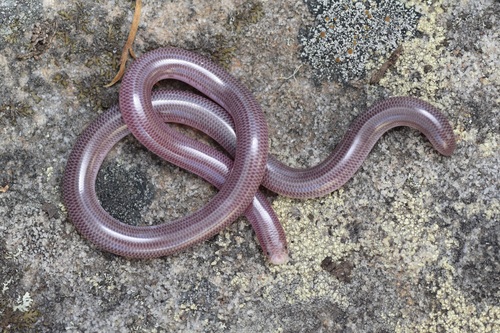
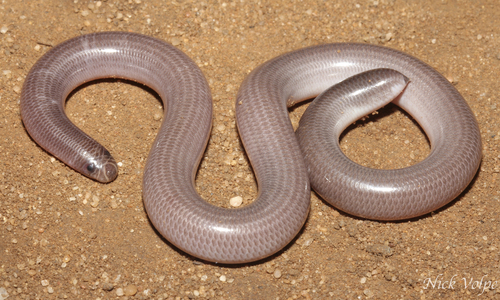
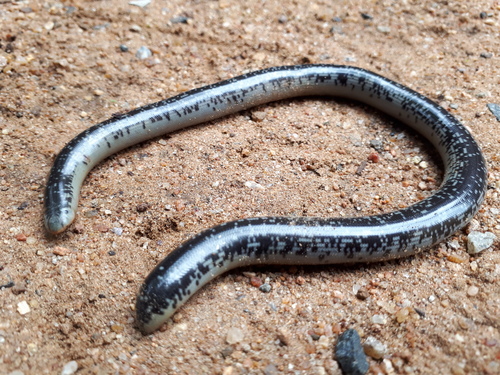
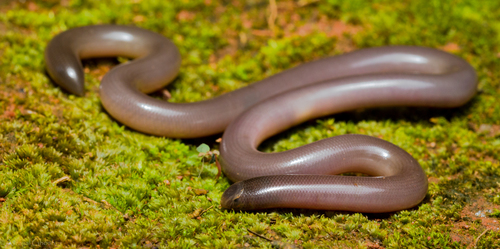
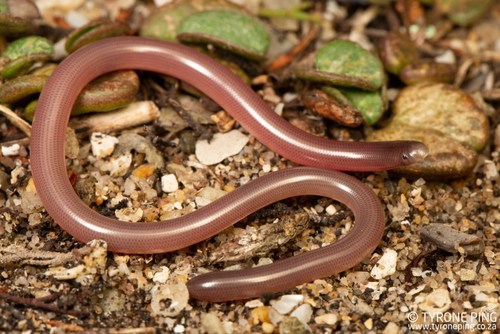
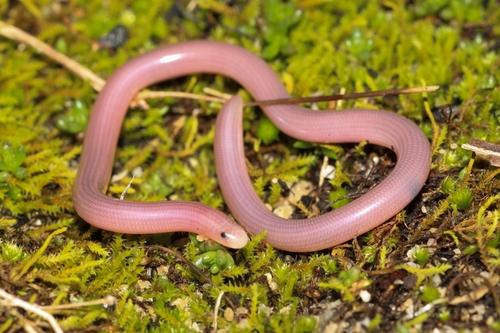
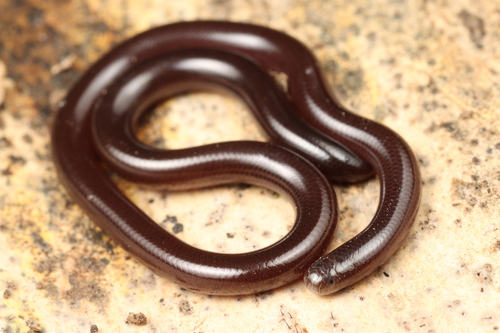
Adults of Indotyphlops braminus, the Brahminy blind snake, measure 2–4 inches (5.1–10.2 cm) long, rarely reaching 6 inches (15 cm), which makes it the smallest known snake species. Its head and neck are not distinct, so the head and tail look superficially similar. Unlike most other snakes, the scales on its head match the scales on its body. Its eyes are barely visible as small dots located underneath the head scales. The tip of its tail has a small, pointed spur. Fourteen rows of dorsal scales run along the length of its body. Its coloration can be charcoal gray, silver-gray, light yellow-beige, or purplish; albinos are rare. Its ventral surface is typically paler than the rest of its body. Juveniles have the same coloration as adults. Its behavior can range from lethargic when in suitable habitat to energetic, quickly moving into soil or leaf litter cover to avoid light. Its tiny eyes are covered by translucent scales, leaving the snake almost completely blind. While its eyes cannot form images, they are still able to detect differences in light intensity. Indotyphlops braminus is most likely originally native to Africa and Asia, but has been introduced to many regions across the world including Australia, the Americas, and Oceania. Vertically, it occurs from sea level up to 1,200 metres (3,900 ft) in Sri Lanka, and up to 1,500 metres (4,900 ft) in Guatemala. Its type locality is given as "Vishakhapatam", India. In its native African range, it has been recorded in Uganda, DRC, Egypt, Kenya, Senegal, Benin, Togo, Nigeria, Ivory Coast, Cameroon, Zambia, Zimbabwe, Somalia, Zanzibar, Tanzania, Mozambique, South Africa (with an isolated colony in Cape Town and Natal Midlands; around eight individuals have been found in Lephalale, Limpopo Province at the Medupi Power Station during construction), Madagascar (Nossi Be), the Comoro Islands, Mauritius, the Mascarene Islands, the Seychelles, and Libya. In its native Asian range, it occurs on the Arabian Peninsula, and in Lebanon, Iran, Iraq, Philippines, Pakistan, Nepal, mainland India, the Andaman Islands, the Nicobar Islands, the Lakshadweep Islands (where it is the only snake reported), the Maldives, Sri Lanka, Bangladesh, Myanmar, Singapore, the Malay Peninsula, Thailand, Cambodia, Vietnam, Laos, southern China (including Hainan), Hong Kong, Taiwan, and Japan (on the Ryukyu Islands of Okinawashima and Miyakoshima). In Maritime Southeast Asia, it occurs on Sumatra and nearby islands (the Riau Archipelago, Bangka, Belitung and Nias), Borneo, Sulawesi, the Philippines, Java, Bali, Flores, East Timor, the Kai Islands, the Aru Islands, New Guinea (Western Papua and Papua New Guinea), New Britain, and Bougainville Island. It is also found on the Cocos (Keeling) Islands and Christmas Island. In its introduced range, in Australia it occurs in the Northern Territory near Darwin, and in parts of Queensland. In Oceania, it occurs on Papua New Guinea, Palau, Guam, Fiji, Saipan, the Hawaiian Islands and Tahiti in French Polynesia. In the Americas, it occurs in the United States (California, Connecticut, Florida, Georgia, Louisiana, Massachusetts, Arizona, Hawaii and Texas), western and southern Mexico, Guatemala, Belize, Colombia, Barbados, the Cayman Islands, and the Turks and Caicos Islands. It has also been spotted in the Okanagan region of B.C., Canada. In Europe, it has been found in Spain (on the Canary Islands of Tenerife and Gran Canaria), Italy (on the island of Ischia), and Malta. It is thought to have been introduced via soil imported with potted plants, and has been classified as potentially invasive to native fauna. Brahminy blind snakes usually occupy urban and agricultural areas. This species lives underground within ant and termite nests. It can also be found under logs, moist leaves, stones, and humus in wet forest, dry jungle, abandoned buildings, and even city gardens. The distribution and survival of this group of blind snakes directly corresponds to soil humidity and temperature. Indotyphlops braminus is parthenogenetic, and every specimen collected to date has been female. It may either lay eggs or give birth to live young. It produces up to eight offspring at a time, all female and genetically identical. Offspring are triploid. Because this species has obligate parthenogenesis, it has been proposed that it be moved to a new genus as Virgotyphlops braminus.