About Indosylvirana temporalis (Günther, 1864)
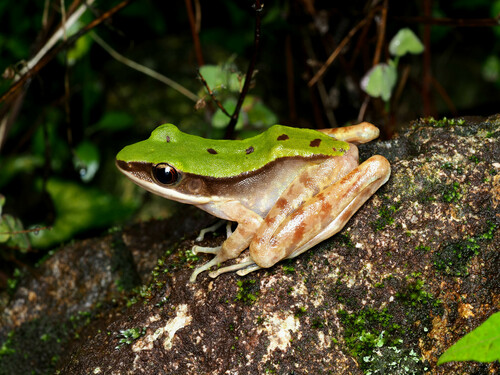
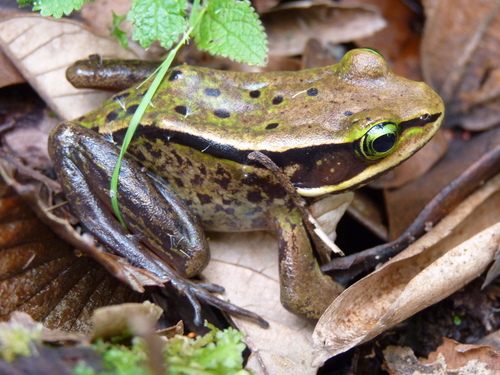
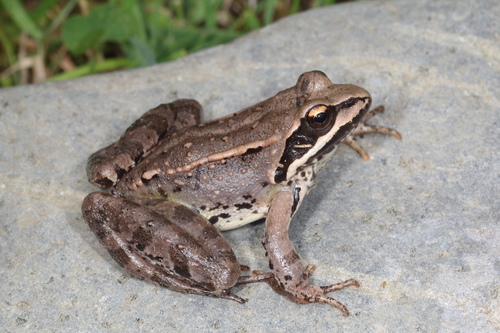
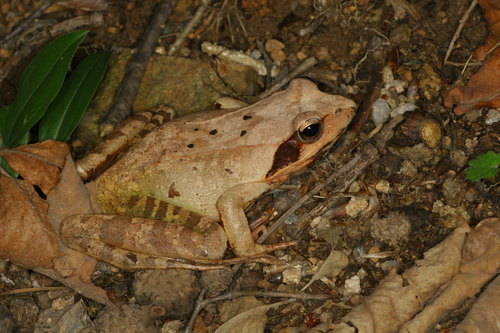
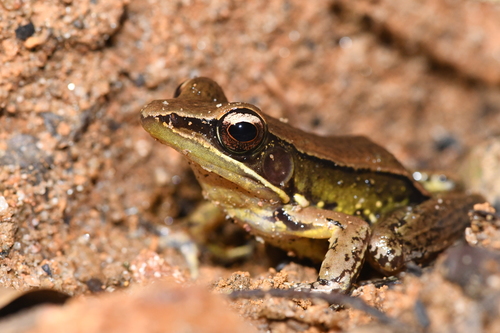
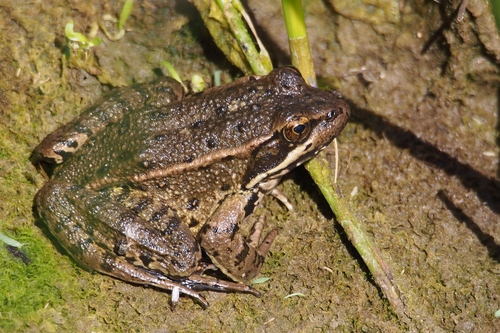
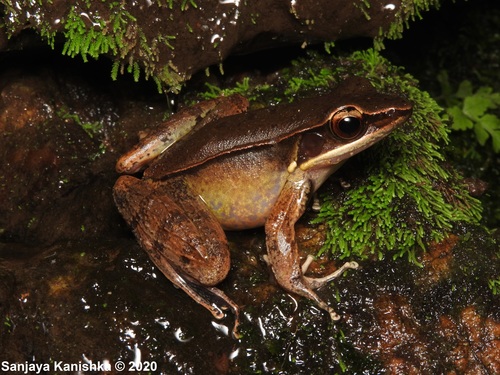
This species is scientifically named Indosylvirana temporalis (Günther, 1864), commonly known as the bronzed frog. Its vomerine teeth are arranged in two oblique series that extend past the level of the hind edge of the choanae. The head is depressed and triangular, and the snout is subacuminate and prominent. The canthus rostralis is angular, while the loreal region is nearly vertical and strongly concave. The interorbital space is as broad as the upper eyelid, or rather broader in some individuals. The tympanum is very distinct, and matches the size of the eye, though it may be slightly smaller in some frogs. Digits are moderate in size, with the first digit extending beyond the second. Toes are almost entirely webbed, and the tips of both fingers and toes are dilated into well-developed disks. Subarticular tubercles are well developed; the inner metatarsal tubercle is oval and blunt, and there is a small, round outer metatarsal tubercle, with no tarsal fold. The tibiotarsal articulation reaches between the nostril and the tip of the snout, and may extend a little past the snout tip in some individuals. The dorsal skin is either smooth or finely granulate, with a narrow glandular lateral fold. Dorsal regions are brown, while the loreal and temporal regions, and sometimes the sides of the body, are dark brown. A white labial band may be present, and the limbs have dark cross bands. Ventral parts are typically white, with the throat and breast more or less speckled with brown spots. Males have internal vocal sacs, oval flat glands on the inner side of their arms, and a strong pad on the inner side of the first finger that is covered with a greyish brown velvet-like horny layer during the breeding season. This species is found only in Sri Lanka, where it occurs chiefly along the edges of rocky streams at low altitudes. Individuals sit exposed on flat rocks and stones, and will leap, often to a considerable distance, into the water when disturbed. Tadpoles of this species detect food using chemical cues rather than visual cues, meaning chemical perception is predominant over visual senses for I. temporalis tadpoles.