About Indigofera linnaei Ali
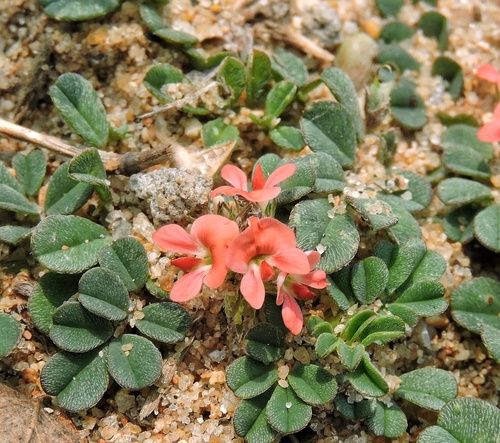
Indigofera linnaei Ali, also referenced as Indigofera tsiangiana, is a usually prostrate, spreading woody herb that grows 15–50 cm tall, with a long taproot. It forms a flat mat that can reach up to 1.5 m across and up to 45 cm high. Its branches are covered in appressed white hairs. It has peltate compound leaves up to 3–5 cm long, which usually bear 7 or 9 alternate leaflets. Leaflets are obovate or obovate-cuneate, mucronate at the apex, 8–15 mm long and 2–5 mm wide, and covered with fine silky hairs on both sides. Stipules are lanceolate, 3–5 mm long, lateral and free, with broad, dry margins, and covered with silky hairs. Inflorescences are dense, subsessile glomerule-like spikes 1–2 cm long, holding from just a few up to 25 flowers. Bracts are lanceolate, 3–4 mm long, pubescent and scarious, with a strong central vein ending in an acuminate tip. Flowers are sessile, around 5 mm long. The calyx is campanulate, 3–5 mm long, covered with spreading white villous hairs, with narrow acuminate teeth that are much longer than the calyx tube. All petals are red; the standard petal is obovate-spathulate and slightly longer than the calyx, while the wings and keel are shorter and inserted. The fruit is an oblong, silky pod 3–7 mm long, pointed at the apex, that usually contains two seeds. In the Northern Territory of Australia, it is a weedy species often found in disturbed or overgrazed areas, growing on a variety of soil types including skeletal soils, red sand, and cracking clay. In this region it flowers and fruits year-round. In Western Australia, it flowers from January to May, growing on sandy soils, sandstone and limestone ridges, along rivers and creeks, and on rocky hillsides. It is not classified as a species of conservation concern in Western Australia under the Declared Rare and Priority Flora List. This species is distributed across Sudan, much of tropical Asia including Assam, Tamil Nadu, Bangladesh, the Bismarck Archipelago, China, the Himalaya, Hainan, India, Indonesia, Laos, the Lesser Sunda Islands, the Maldives, Myanmar, Nepal, New Guinea, Pakistan, Sri Lanka, Sulawesi, Thailand, and Vietnam, and also in Australia. Within Australia, it occurs in Queensland, Western Australia, the Northern Territory, New South Wales, and South Australia. This plant was identified only after considerable time as the species that causes Birdsville disease, a condition affecting horses in arid and semi-arid Australia. Everist originally suspected the causal agent was indospicene, also spelled indospicine, or possibly cavananine. Current research confirms that the neurotoxic effects of Birdsville disease in horses are caused by the neurotoxin 3 nitropropionic acid (3-NPA), and that horses are less susceptible than cattle to the hepatotoxic effects of indospicine. Neurotoxic effects in horses generally occur just after rain, as this species responds more quickly to moisture than other local plants. Indospicine accumulates in the tissues of grazing livestock after they eat this Indigofera, causing liver degeneration and abortion across animal species, though the severity of these effects varies considerably between species. Dogs have very high sensitivity: eating indospicine-contaminated horse or camel meat has caused secondary poisoning in dogs. Chronic cumulative exposure to this toxin from grazing Indigofera has been experimentally shown to induce both hepatotoxicity and embryo-lethal effects in cattle and sheep.