About Indicator variegatus R.Lesson, 1830
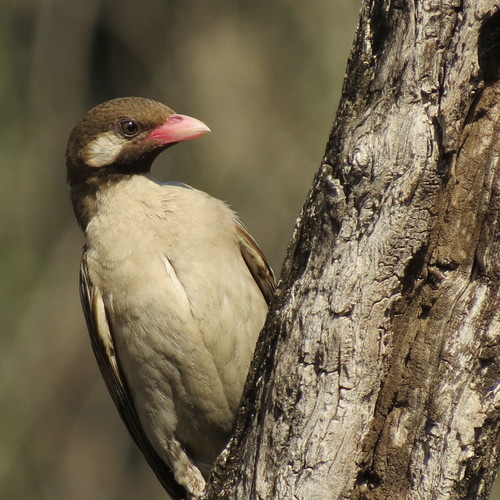
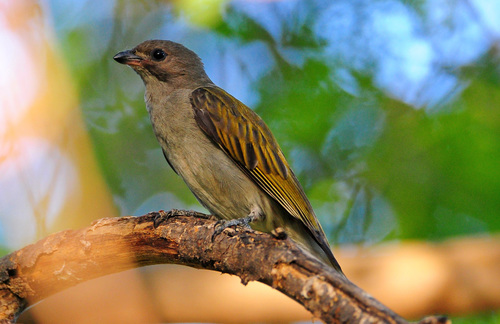
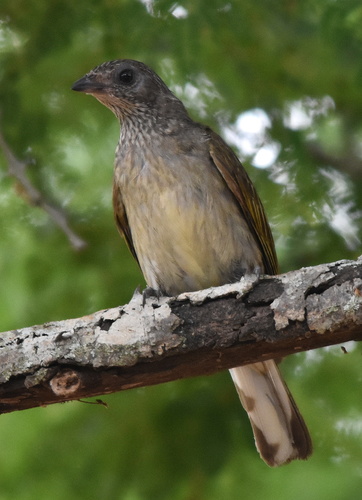
Mature scaly-throated honeyguides (Indicator variegatus R.Lesson, 1830) are 18 to 19 centimetres (7.1 to 7.5 in) long, and typically weigh 34 to 55 grams (0.075 to 0.121 lb), occasionally reaching up to 61 grams (0.134 lb). Males are larger than females; recorded male weights range from 50 to 56 grams (0.110 to 0.123 lb), while female weights generally range from 36.6 to 55 grams (0.081 to 0.121 lb). However, male birds in Uganda have been reported to weigh as low as 31 grams (0.068 lb), and females there have been recorded weighing up to 60.5 grams (0.133 lb). The scaly-throated honeyguide appears olive overall, with a white or buffy yellow tinge that is most distinct on its middle and lower breast. The color and pattern of its throat and breast varies between scaly and streaky olive-gray and white. These breast markings distinguish the species from other honeyguides, with the exception of the spotted honeyguide. It can be told apart from the spotted honeyguide by its less green, browner upperparts, paler and grayer underparts, and reduced spotting. Stripes are present on its face and crown, and these stripes sometimes extend to its nape. It has an olive-brown upper back, which becomes more greenish toward the mid-back. Its rump is yellow-green, and its tail has a black-tipped white outer pattern with short outermost feathers. Its legs and feet are most often greenish-gray or yellowish-olive. Its eye color ranges from hazel to gray brown or deep brown. Immature scaly-throated honeyguides have greener coloring on the throat and breast, which is also marked with broader, blacker spots. Immatures have darker cheeks and crowns, more finely streaked head patterning, and a tail that is nearly all white. Adult males have a black gape, while adult females have a pink gape with some dusky gray that becomes more visible in older females. This species is found in Angola, Burundi, DRC, Eswatini, Ethiopia, Kenya, Malawi, Mozambique, Rwanda, Somalia, South Africa, South Sudan, Tanzania, Uganda, Zambia, and Zimbabwe. It inhabits dense woodland, thickets, forest, overgrown plantations, and bamboo, and is usually only identifiable by its high-pitched, trill-like ascending call. It typically occurs at elevations below 2,200 metres (7,200 ft), but has been observed at up to 3,350 metres (10,990 ft) on Mt. Elgon.