About Incurvaria pectinea Haworth, 1828
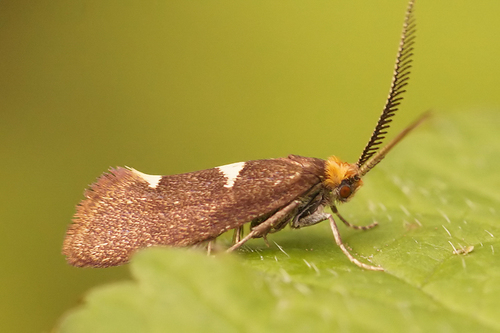
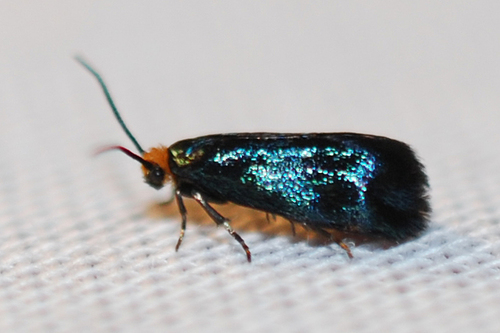
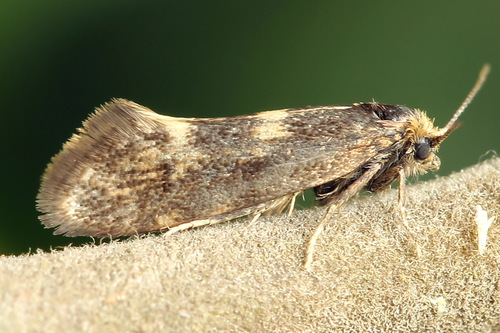
Incurvaria pectinea Haworth, 1828 is a moth species belonging to the family Incurvariidae, found across Europe. This is a medium-sized moth with a wingspan ranging from 13 to 16 mm, with an overall brownish coloration. It can resemble other species in the Incurvaria genus, but can be distinguished by its somewhat narrower wings, paler overall color, and less distinct pale spots along the trailing edge of the forewing. Males have comb-shaped antennae that reach approximately two-thirds the length of the forewing, while females have filamentous antennae with protruding hairs that reach around half the length of the forewing. The head is covered in long, erect, yellowish hair-like scales, giving it a rather disheveled appearance. The forewing is narrow and pale greyish-brown, with two inconspicuous light spots along its hind edge that are less distinct than those found on other Incurvaria species. The innermost spot is typically larger than the outermost spot, and in some individuals the spots may be completely absent. The hindwing is greyish-brown, edged with long, greyish-brown hairy fringes. The larva is whitish, with a yellowish-brown head and greyish-brown dorsal plates on its first three body segments. Meyrick's description notes a pale greyish-ochreous head, shining prismatic fuscous forewings with a yellow-whitish dorsal spot before the middle and an indistinct dot before the tornus, and brassy-grey hindwings. Adult moths fly from April to May, or from late April to early June, depending on location. The species can be found almost anywhere that deciduous trees grow. Larvae feed on a variety of deciduous tree species, including birch, hazel, and apple. Females lay several eggs on each host leaf, and larvae develop inside leaves. Newly hatched larvae first create a small, round leaf mine. They then chew their way out of the mine, construct a protective casing from leaf fragments and silk, lower themselves to the ground, and spend the rest of their larval development feeding on fallen leaves. Infested leaves may be heavily pierced after larvae have left them.